“Retreat!!!”

“Retreat!” The command conjures images of troops scurrying away from an onslaught of bullets, bayonets, and cannonballs. Smoke lifts from the battlefield and casualties lay dead and dying.

Last week I felt like a tired soldier– exhausted, bloody and bruised. Truly, the metaphor is a little dramatic but when I arrived at VCFA for the weekend Alumni Mini Residency, I was stressed, and tired, and well… sad. Not only have I been a geographical single parent since January (my husband is deployed with the US Navy) but six weeks ago, I sent my other love, my YA manuscript, out into the world of literary agents and it has been met with an ear-splitting silence. (BTW: No response as a decline is neither courteous nor professional  but that has already been hashed and rehashed. Argh.)

Throughout the weekend, the energy and love of friends helped me shed my sadness. I gave and got plenty of hugs, took copious notes at lectures and workshop, and spent way too much money on dinners. Then came the retreat.

Four days of relaxation and writing at an 1828 farmhouse in Sheffield, Massachusetts. A day in the life? We all woke at our own pace. We flipped open laptops and got to work– some writing, some revising, some emailing, some reading. The work was punctuated with laughter, conversation, and questions: “So in the subjunctive…” or “How would a thirteen year old say…” or “Hey, the stuff I wrote yesterday isn’t half bad!” Writer’s bliss.

Lovely kitchen garden with busy hummingbirds and chipmunk visitors.

Because we all pitched in on meals and clean-up, the place felt like home even though it looked like a high-scale B&B. When things got particularly hot and humid, and the fans weren’t doing their job, we went swimming or took guilt-free naps. (Naps, by the way, are crucial to the creative process. More on this later.)

Coming home, I realized that my shoulders had dropped about four inches of tension. I was happy, relaxed and rejuvenated– ready to face another round of agent submissions and to welcome my children home from sleep-away camp.

Member Monday: Stages of writing ala L.B. Schulman

This post, Chugging through the Stages of a Writing Career, on EMU’s Debuts is so wonderful and helpful for beginning through PAL authors that I thought I’d post the link here and let you enjoy L. B. Schulman‘s words today.

I will add that there is a mental piece that I’ve found very important that is not addressed in her post. Here’s how it worked for me. After eight years of being active in SCBWI, and following the industry, and researching agents and writing and getting a first agent, and asking questions at workshops, and conferences, and retreats… I felt my writing knowledge had plateaued. I entered Vermont College of Fine Arts in July of 2009 because I no longer knew what questions to ask. Diving deep into craft, forgetting about the industry and rediscovering my love for writing and my love for the craft of writing made me realize that I would be– will always be a writer. I think this happened to me somewhere between my fourth semester at VCFA and my graduate residency. 

Do I want to my book published? Yes, and I’m working at it every day, but if it never happens I will still be a writer. My dear friend Lita Judge calls it “finding your calm.”

Currently, I am finishing my fourth week calmly waiting to hear from agents.
*checks clock, pops cork, drinks wine*

Where are you on L.B. Schulman’s list of stages and how does SCBWI meet or not meet your needs?

Mama Camp in Pictures

You may have noticed (or not) that posts are less regular here at Creative Chaos. That’s because my full time job as Director of Mama Camp (read: parenting) has kicked into full gear. There have been many field trips.

Trips to Hadlock Field to watch the Portland Seadogs.
Number two son kayaking at Sewell Pond.
Number one son climbing the “jumping tree” at Sewell Pond for the first time.
Window shopping in Newburyport with cousins.
Jumping frigid waves at Plum Island.

And lots of time at the best library on Earth, Curtis Memorial Library where we are busy with fun crafts:

Paper bag owls.

the coolest Teen Zone ever:

CML Teen Zone with awesome graphic novel/manga collection and great audio books.

wonderful lifesized animal sculptures (there’s also a whale, a unicorn, and a friendly boar):

Number two son and paper maché giraffe.

and the best of all… Fabulous librarians who care about books and kids:

The best Youth Services librarians ev-er!

You can imagine with all this action that there has been little time to blog, or to write for that matter. Here’s what I’ve been trying to fit in between Mama Camp and sleeping.

  • Rowing (Link for video. I’m in three seat. The camera moves to starboard around 4:44)
  • Running (Sadly I haven’t been biking but I need to change my rear tube.)
  • A work-for-hire editing project that has been an awesome experience.
  • Subbing to agents for the first time in three years. Nothing yet. (BEA, ALA, and 4th of July are now over. I’m on pins and needles.)
  • Working on NESCBWI Illustrator Day. Save the date: September 29th, 2012.

Happily, sleep away camp is a couple weeks away and I’m eager for the break. I’ll take that time to go to the VCFA Alumni Mini Rez and a writing retreat. I’m psyched to see everyone. Cross your fingers that I’ll have good news to share by the time I get there.

Happy summer.

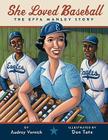
Book Review Wednesday: She Loved Baseball


Shop Indie Bookstores

The picture book biography is a great way to get kids interested in history. (Previous reviews of PB Biographies here and here.) A good PB biography author needs a hook– a place for a young reader to access the story. This entry point is often hard to find. Audrey Vernick found a great hook, a sister’s desire to play baseball with her brothers, in SHE LOVED BASEBALL: THE EFFA MANLEY STORY.

Effa’s principal discourages her from playing with her own brothers because their skin is dark and hers is light. This scene sets the reader up for the story of Effa’s tenacious resistance to the segregation and bigotry of 1930’s and 1940’s and her love of baseball.

Effa Manley became one of the great business women in the Negro League. She cared for her players in the Newark Eagles and was eventually respected by other owners in the league. Especially interesting to me was the fact that Negro League owners were not always paid for their contracted ball players when the players were finally accepted/hired by white teams. Effa changed that with a press campaign. Later, her letter writing campaign in the 1970’s to the National Baseball Hall of Fame started the induction of Negro League players. She was posthumously honored by the National Baseball Hall of Fame for her civil rights work and her work with the Negro Leagues.

Audrey Vernick’s text is well-suited to the picture book format. It is perfect for older elementary students researching on their own or for an adult read-aloud. The text and images are well-matched by illustrator Don Tate. Tate’s gestural figures and expressive faces pull in the reader into the historical period and the narrative.

Neither women’s history (March) or black history (February) need to be relegated to their  honorary months. SHE LOVED BASEBALL can be enjoyed year round.

Member Monday: All in the family

I know, I know. It isn’t Monday. I also know that I didn’t post on Friday. I was rerouted by a wonderful visit from my Mom and Dad, then my sister-in-law, her husband, and her two kiddos (under two years old) showed up. Needless to say, there was no peace or quiet but there was tons of fun. The 20 month old fell in love with our yellow lab. First word out of his mouth each morning? “LUCY!”

With all that was going on: parades, beach, playing outside, weeding gardens, going to baseball games, grocery shopping, laundry… no internet happened at all. No blogging, no email responses, no twitter and absolutely nothing wrong with that. It was great to get a break from the computer. The world in front of us and all around us is the one we must inhabit. Still, as a writer, the worlds I build in my WIP’s often seem as real, and as important as those flesh and blood settings in which I reside. A part of me needs the solitary activities of writing and drawing.

This makes me think about the upcoming summer months. Writing definitely has its rhythms. I write more in the October to December, and January to April season then most of the rest of the year, but I’d like to work all year long. I pulled my kiddos aside last night at dinner to discuss the fact that Mom still wants to work even when they are out of school. Did they have suggestions about how we would manage that? The conversation quickly refocused on them and whether or not they were old enough for jobs in town so I never got my answer. I’m curious, how do those of you with tweens and young teens make time to write in the summer?

At home today, waves of thunder and lightning crash outside my window. In the quiet space in between, the rain beats on the shingles, and birds twitter and chirp. My house is dark and calm and silent. Dog is snuggled on the rug. I am revising.

Book Review Wednesday: Duck Sock Hop

There’s nothing I like better than getting a new book in the mail. Yesterday, I found this…


Shop Indie Bookstores

DUCK SOCK  HOP
Dial Books For Young Readers (2012)
By: Jane Kohuth
Illu: Jane Porter

I loved it so much I had to write about it right away.

Jane Kohuth engages readers and listeners alike on a variety of levels. First we get the  rhythmic text about ducks who like to wear socks and dance, with playful, spot-on, finger- snapping, toe-tapping rhyme. On second look, the parent reader can point out a variety of concepts: shapes, colors, opposites (right/left, high/low) numbers “three ducks boogie, one duck rocks. Two ducks stop and trade their socks.”

The wonderful thing about this book is that it is a perfect example of how a picture books can include a plot arc with a conflict. (This is something that I often have to mention in editorial situations.) After the ducks boogie and rock, they dance holes in their socks. Kohuth gives enough fun-loving time at the beginning of the story for the readers to fall in love with, and really care for the ducks, so we really feel sad when the dancing is interrupted. The change of mood also adds much needed change-up to the rhyme and rhythm. The adult-reader gets a chance to involve the child listener, “What are the ducks going to do?” The solution– Band-Aids and snacks, make ducks infinitely relatable to the toddler set.

Debut illustrator Jane Porter places the brightly colored ducks on fields of white. In the following video she describes her process. She draws using india ink and often uses a stick as her drawing tool.  Readers of DUCK SOCK HOP can feel the dance-y movement in the gestural quality of her drawing. Next, she layers on color and texture digital. In this book, the duck feathers and the sock details both have a wonderful print feel.

Jane Porter Interview

If your kiddo liked…


Shop Indie Bookstores

or…

Shop Indie Bookstores

They’ll love DUCK SOCK HOP!

Member Monday: The Children’s Book Industry, A gendered affair

A disclaimer is always at the bottom of this blog but before today’s post I just want to make sure it’s seen:

Disclaimer: As always: Any opinions expressed here are entirely my own and not the views of the SCBWI. FMI http://www.scbwi.com

Phew. Done.

Yesterday, as you probably know, was Mother’s Day here in America. Google made a super-cute, animated logo that jumped to the Wikipedia explanation of the founding of Mother’s Day by Anna Jarvis in 1908. Earlier though, in 1870 at the end of the bloody Civil War, Julia Ward Howe called for a Mother’s Day in honor of Peace. She, who wrote the Battle Hymn of the Republic, also wrote the Mother’s Day Proclamation. In the spirit of activism and women– today’s post.

What does Mother’s Day have to do with the Children’s Book Industry? Well, I’d bet money that a lot more than 50% of my (small) readership is women. How do I know? Go to any SCBWI conference and check out the bathrooms. We always switch one men’s room to a woman’s room in order to handle the demand. It’s not only the writers either. A large number of the editors and other industry professionals are women too– strong, intelligent, wonderful women.

In the illustration department the numbers start to sway. More men tend to be illustrators we know. Of the 12 illustrators in the “Bookmakers Dozen” only three are women. 

Now think about the people you see keynoting at national SCBWI conferences. The folks we know have really made it. Often men. I have nothing against these strong, intelligent, wonderful, men and I have to say that the tide IS changing. At the last few big conferences I attended, the podium seemed much more balanced. Nevertheless, one might ask… no, I ask… Why is it that we have an industry that is primarily female but whose big money makers are mainly male.

I’ve talked to a lot of people about this and have stitched together some thoughts on the issue. Below are four mistakes that women often make and men often don’t. (Let me mention that I do all of these things, all the time.)

1. Women often give away, that for which they should be compensated.
Think of your calendar, or list of things to do. How many times have you scheduled volunteer activities? Certainly there is nothing wrong with that, but all of those duties (often in service to our children) take away from time that you might do the work.  Further, how many times do you go into classrooms, or libraries to do readings or writing workshops for free? How much do you give away your Children’s Writing/Illustrating/or Publishing expertise?

Tip: Some pro bono work helps us get quotes and recommendations for our blogs, and helps us market ourselves, but have some sort of rule about how many or what kind of visit you will do for free and when those are done, say no to free visits.

2. Women often settle for compensation that is below the market value.
Our work and our knowledge is worth something. What is it worth? That is harder to determine. Some of us are published in magazines, some have books, some have awards. The Graphic Artist Guild has a Pricing and Ethical Guidelines publication that pools payment info and organizes it according to job and region so that illustrators/graphic artist have a better idea about the going rate and therefore know what to charge. Alexis O’Neill has this PDF entitled “What do I charge?” at her School Visit Experts.com site. I think it would be interesting to have a survey of all SCBWI members about their visit and conference fees and to publish the results. Even if we knew what to charge though, women often settle for less. If you don’t believe me take a look at this book, or this book, or this article, or this one, or this one.

Tip: Do some research and ask people you respect how much they charge. I know, it’s scary. Ask anyway. Try to zero in on your worth and stick to it when a school starts telling you they don’t have any money. Research outside funding sources or grants that they could apply for in order to pay you your stated price. Ultimately, you are trying to sell books. Could they schedule a book signing event for the school where they contract with a local indie bookseller?  In terms of book contracts– get an agent. It used to be that those in the Children’s Industry didn’t need one. Those days are gone. Most publishing houses are closed to unagented manuscripts and the extra money you will get with an agent who knows editors and their contracts is significant.

3. Women often over-schedule outside events which leaves less time to do the work.
Anytime you are not writing, illustrating, sketching, revising, reading critically, you are not doing the work. Ultimately, your teaching or your school and conference visits depend on your publishing calendar. New books, mean new visits.

Tip: Be deliberate when scheduling visits. Budget out your year. Say to yourself, I want to make this much money from visits this year. I’ll need to do this many visits to make that happen. Try breaking your year into school visit season and writing season. You probably know your own work rhythms. Are you unproductive in January and February? Schedule all your travel and visits then.

4. Women have a lot they are responsible for and this keeps us from doing the work.
Many of us have a ton of domestic responsibilities. We drive children, do laundry, take care of our parents, and on, and on, and on. Ultimately, we will not get the book contracts if we don’t do the work. We can wait for another more favorable time (which may never come) or we can “write in the cracks,” a term I’m borrowing from Eileen Spinelli. Further, at-home loneliness often drives people (read: me) to social networking sites where we convince ourselves that we are building an online platform for the magical day when our book is purchased.

Tip: Value yourself and your work enough to get a babysitter, then run away and write or draw. If you have a spouse, negotiate time on your own and schedule it in the family calendar. Take a pen and notebook and write on the road. If your kid is in baseball practice, stay in the car and write or sketch. You don’t need a laptop and you especially don’t need the internet. If you are not published and that is your goal, I challenge you to find one hour each day when you are “building your online platform,” to do the work.

In closing– Value your time. Value your knowledge. Do the work. 

Poetry Friday: Novels In Verse

I haven’t blogged this week. Partly because I was recovering from the events I organized for Poem in Your Pocket week, but partly because I’ve been sitting on this rather long post about Novels in Verse. I hope you’ll grab a cup of tea, stay awhile, and read. I’d love to hear your comments and opinions on this and really start a discussion about the verse novel structure.

Karen Hesse’s, OUT OF THE DUST (1997) was the first novel in verse that I read. The book, its structure and historical subject matter captivated me. Since then, the genre has exploded. Many kids like the novels in verse format because they are generally a faster read then a traditionally structured novel. The poetic structure of a verse novel can also make difficult or historic subjects more accessible. If you haven’t read many novels in verse, or verse novels you can find good lists of them here, here and here.

First, we should define verse. If one is writing “in verse,” there is some set rhythm or fixed metrical line to their poetry. [For example, iambic pentameter– or 5 iambs (2 syllables- soft-hard)]. Confusing the definition these days is that verse can also mean stanza or any poetry in general. This includes free verse, which has no “verse” or fixed rhythm at all.

Maybe part of my problem is that there is no real definition of what the verse novel structure needs to be. A sonnet, a haiku, a pantoum: all of these follow rules and I’m a rule follower. Let me be clear. I do not think that all novels in verse have to have a fixed or formal meter or rhyme scheme. I understand that there is a difference between a novel in verse and a collection of poems that tell a story. However, if a novel announces that it is in verse I do want to see the use of figurative language (metaphor, simile, onomatopoeia, hyperbole, etc.) and/or sound devices (assonance, consonance, and alliteration) in addition to line breaks.

Any dedicated author chooses each word after careful consideration and considerable hair pulling. She wants to be appreciated for the rhythmic quality of her words. She wants someone to say, “I never would have thought of that particular metaphor,”or “What a beautiful image,” or “This reads like poetry.” Yet even though some prose is poetic, not all novels work in verse.

When a novel in verse doesn’t work for me, I fight with myself. On one hand, I want to see kids exposed to poetry, and I think there are a variety of ways to tell a story well. On the other hand, I have questions about the legitimacy of the form. What makes a novel in verse? Is it enough for a writer to simply employ line breaks and call it poetry? What about figurative language, and formal poetic form? But wait, I counter, isn’t the line break a legitimate tool of the poet?

Many authors defend the form saying that line breaks are a valid poetic tool. The breaks allow the reader to fill in the space between what is written and what is implied. Absolutely! This is similar to the space between the panels in a graphic novel or comic strip. The reader creates, as Scott McCloud says, “closure” filling in the gaps between the frames. Holly Thompson, RA from SCBWI Japan and author of the verse novel ORCHARDS wrote in her Hatbooks Blog ,“In a verse novel all that white space needs to carry meaning.” (And I would add emotion.)

Here’s my problem, in too many “novels in verse,” I could easily get rid of the line breaks and the passage would read perfectly well. No space for the reader. No closure necessary.

One of my very favorite novels for children is, A CROOKED KIND OF PERFECT by Linda Urban. I listened to this book before I read it, (I highly recommend the audio version BTW) and I wondered, as I listened to the first few short, titled chapters, if Linda had written a novel in verse. It is poetic, and rhythmic. When I picked up the printed book I was pleased to see that she had written the book in prose but her language, emotion, and sensory details were so beautiful, honest, and specific that it read like poetry. I spoke to her at the recent NESCBWI conference and asked her if she had considered writing a novel in verse. She said no, but the novel in verse format gave her the liberty to consider a different format.

I shared an elevator ride with fellow poetry lover Kelly Fineman at the NESCBWI conference where we discussed the issue briefly. She’s done a number of interviews on her blog with authors of verse novels. Perhaps she’ll chime in here with an opinion.

Unfortunately, I’m ending where I started– with no real answers. However, since I’m considering this structure for one of my own WIP’s, I’ll continue to study the genre. What novels in verse do you love and why? What makes a novel in verse work, or not work for you? I’d love your thoughts in the comments below. 

Poem in Your Pocket Day!!!

If you didn’t already know, it’s Poem in Your Pocket Day. Since September, I’ve been working with two other community organizers, planning events, applying for grants, finding sponsors, designing posters and social networking around this fabulous, stupendous day!

Today I walked Maine Street in Brunswick with a bag of poem and stickers and handed them out to anyone who would take them. I visited the Little Dog Café, The Bohemian Coffee House, Frosty’s and Wild Oats. Some folks said they had heard about Poem in Your Pocket Day on the radio. Maybe this story. The smiles that I got in exchange for the poems made my day. My favorite interactions occurred when a few people told me they didn’t need one of my poems because they already had poems of their own! Listening to them read was lightness, and sunshine, and warm smiles.

One little girl with her Grandmother took my poem and sticker but the little girl was extremely shy. I left, walked the entire town then came back to my car. “Wait,” I heard. It was the Grandmother. “My granddaughter and I have been looking all over Brunswick for you. She wanted to give you this.” She handed me a poem that they had written out after I’d left. I think they made it up together. It made my day. Here it is:

Tulip
Tulip in the ground unplanted
We circle ’round and ’round
We wonder where it came from
Growing dizzy, falling down

TONIGHT, April 26th: Open Mic Night, 6:30-8:30, Curtis Memorial Library. Come read one poem. Yours or someone else’s. Must be family friendly. Sign-up when you arrive.

TOMORROW, April 27th: Reading by Wesley McNair, Maine’s Poet Laureate, 6:30-8:30, Curtis Memorial Library. Wes will have some books available for sale.

Poem in your pocket day will soon be gone. Quick, stuff your pocket with poems and share, share, share!

Member Monday: 15 Minutes to a Great Critique

Usually blog posts take a while for me to construct but at the suggestion of Julie Kingsley today’s post is going to be done in 15 minutes or less– perfect for our subject the conference critique. Just like at the conference, I’ve set a 15 minute timer (I actually have eggs boiling at the same time) and at the end of the 15 minutes, a bell will ring. At the conference, the timer is a wonderful volunteer who has nothing to do with finding the crit faculty or matching you up so if you are not pleased, they are not the person to whom you should bring grievances. You’ll start the crit by signing in with the timer 5 minutes earlier than your scheduled time, but your crit actually should start way before that.

In a quiet moment before the conference begins, perhaps when you are in your hotel room, pull up the 10 pages that you sent in to be critiqued. Hopefully you haven’t seen these ten pages in a while. Pull out a notebook, Pretend that you are the editor or agent, or put on the hat you’d wear if a close writing friend gave you their work and said, “Really. I want you to be honest. I want to be a better writer.” Read through the ten pages and jot down the challenges in voice, character development, pacing, and setting. Is the beginning engaging? Is the problem clear? Is the main character’s desire clear? Has the conflict been introduced? Even it it is a picture book, you can still ask these questions. Now consider the strengths in the same areas. Also look at the rhythm of your word choice and  language. On the page in your notebook, write Dear Author: and jot down your thoughts in the notebook.

Turn the page. Be the author again. What questions do you have for your critiquer. These could be industry questions but really these 15 minutes are all about you and your manuscript. Questions that will help you solve the problems you noticed in your own writing sample such as: Did you find my main character likeable and realistic? Should I introduce the conflict sooner? Does my antagonist seem cliché? Any issues that have been niggling at you that you’d really like answered by an editor or agent. If it is an agent you may think about asking some of these questions.

You are reacquainted with your manuscript, you have questions to ask, you are ready for the crit. Sign in with the timer and when she says it is time, go straight to the table where you’ll be critiqued. Make eye contact, smile, shake hands (firm). Now… OPEN YOUR MIND! LISTEN!

The critiquer should pull out your writing sample and a letter she’s written that is probably pretty similar to the one you wrote to yourself. Have your notebook ready and a clean page to take notes. Chances are, your heart is beating and you won’t remember a lot of this. Write down good things with a + next to it and challenges she noticed with a -. This should all be in the letter too but it is nice to have a record of the discussion.

If there is still time, she’ll ask you for your questions. Choose the most pressing ones and ask those first. Take notes on the answers. Just as the bell dings, say, “I’m excited to work on this with the revisions you’ve suggested. Would you like to see this again?”

If they say yes, HOORAY! This is a big deal. Ask about timing– is 6 months okay? a year? Shake hands and go away. Write a thank you card immediately and send it to them at their office.

Notice that there is not one moment– NOT ONE– where you should defend the choices you made in your writing. You should not stand up for your characters. You should not tell the industry professional that someone else told you it was fine or liked it. You take their opinion (you paid for it), you keep an open mind, and later you look at your notes and decide if you- as the author- will choose to make those changes.

Most of all, give yourself a pat on the back for putting your work out there, for coming to the conference, and for moving forward on you journey as a writer.

BTW- this took me longer than 15 minutes to write- AGAIN!