Book Review Wednesday: Olivia Bean, Trivia Queen


Shop Indie Bookstores

OLIVIA BEAN, TRIVIA QUEEN
Delacorte Books for Young Readers
March 13, 2012, 288 Pages
ISBN: 978-0385740524

Donna Gephart won the 2009 SCBWI Sid Fleischman Humor award for her debut novel AS IF BEING 12-3/4 ISN’T BAD ENOUGH, MY MOTHER IS RUNNING FOR PRESIDENT! In OLIVIA BEAN TRIVIA QUEEN, Gephart’s third novel, the author known for her humor does not disappoint.

Olivia Bean has some very clear cut goals. She wants to be better at geography. She wants her father’s approval. She wants a friend. Olivia is sure that the path to her goals is to be a contestant on kid’s week of the game show Jeopardy!. This course of action is not far fetched. All the Bean’s are trivia crazy from Olivia, to her kindergarten brother Charlie, to her absent father. In fact, the bits of trivia that pop up throughout Olivia’s day successfully develop her character and keep the story moving forward.

Gephart creates many true-to-life characters who are full of faults. Perhaps the most flawed is Olivia’s father. An obsessive card player and gambler, he left Olivia’s mother and moved West with Olivia’s best friend’s mother. Just this is enough to turn a reader’s stomach, but Gephart doesn’t stop there. This father schedules calls with his kids and doesn’t follow through. He brushes Olivia off when she needs his support, and he shames her about the challenges she has with geography. Still, Olivia loves him.

Charlie, a five year old who hardly remembers his father, is just as enamored of trivia as Olivia but he prefers the gross variety. If you want to know how many bacteria there are in a square inch of armpit, or why a flamingo pees on its own leg, Charlie Bean can tell you that. Charlie is a constant source of comic relief in this sometimes very serious story. Gephart writes kindergarteners well and the dialogue between Charlie and Olivia is authentic, funny, and often heart warming.

Olivia lives with her journalist mother and almost step-dad Neil. While both are supportive and attentive, Olivia misses her father. She also misses being her mother’s confidant– a relationship that often occurs between a single parent and the oldest child. As the family faces money issues, Olivia matures and comes to terms with the fact that Neil is Mom’s new main source of support.

The book is written in first person present tense. This point of view transmits a sense of urgency– not only the reader, but also the narrator, is unaware of what comes next. Sometimes, the present tense can seem self-conscious and jars the reader out of the story. This was the case in OLIVIA BEAN. The benefit of this technique is that neither readers nor Olivia know if she will make it onto or win Jeopardy!. However, a past tense telling would have been just as exciting and more in keeping with the middle grade genre.

There are subtle chuckles tucked throughout OLIVIA BEAN TRIVIA QUEEN as well as a few laugh out loud moments. In this fast paced story for middle graders, the humor is a successful vehicle for more serious and skillfully handled coming of age issues.

Five on Friday: PI Day edition

1. We just got back from an elementary school “Ensemble and Solo” concert. It’s always great to be in a school setting and just watch kids interacting. There’s the anticipation of going on stage, the side conversations (some mouthed across the gym with accompanied hand motions and facial contortions), and the performances.  I was so impressed by how brave all the kids were.

2. If you missed it, Wednesday, March 14th was PI day. That’s right 3/14…3.14. Young son is a huge fan of PI. He has a PI t-shirt and can recite PI to 26 digits. We had a Geektastic PI celebration with all round food: hamburgers, applesauce in round containers, and smiley fries (the fact that I got them shows what a special event this was). For dessert we made NOT one BUT two pies. One chocolate, peanut butter pie and one apple pie with walnut crumb topping. We invited over our wonderful new neighbors over to help us eat all the sweet treats and I gave a “what is PI anyway”- demonstration. It was an all-around (ugh) good time!

3. I submitted two book review queries this week and I’m working on some poetry for submission. It feels good to be finally getting something off my desk even if it isn’t my WIP. Sometimes I just need smaller projects to work on. A revision is so much easier to handle when the entire word count fits on a single page.

4. Thanks to my VCFA friends, I have made a bit of progress on my WIP revision. I already have a few work periods scheduled next week and feel confident that I will be productive.

5. I bit the bullet this week and plunked down the money for the July VCFA mini-rez. I’ll get to see my dear friends, and get a dose of inspiration in the form of fabulous faculty.

How was your week?

Book Review Wednesday: The Girl Who Could Silence The Wind


Shop Indie Bookstores

Sonia Ocampo’s birth coincided with a terrible storm, but as soon as she was born, the winds went away leaving her family and the village to believe that she had a direct line to God. Her miraculous ability to silence the wind is both her blessing and her curse. In “The Girl Who Could Silence the Wind,” as in her middle grade novel, “Milagros” (Candlewick, 2008), Meg Medina, who has written for adults and children for 15 years, explores the power and pitfalls of the miracle.

At sixteen, Sonia has taken on the maladies, prayers, and dreams of the entire village. She is weighed down by milagros (tiny hand-forged prayer charms) which she wears on a shawl. While many people in Sonia’s fictional mining village make the journey North to pursue economic opportunity, Sonia is the anchor of faith for the village and is unable to explore her own dreams.

Sonia’s village might be in Mexico or Central America but the reader is often unsure. With lyrical writing, Medina creates a fictional world which skirts the edges of reality and magic. The reader is covered in the dust of the mountains, he can hear the promising whistle of the train that runs to the capital, and feel the weight of the milagros on Sonia’s shawl.

The range of female characters in the book is especially compelling. Sonia’s Tia Neli is strong and street smart. Sonia’s mother, while quiet, has a silent strength about her. Conchita Fo, the bar mistress is a wonderful mix of beauty and beast.

Sonia is the strongest of all. Throughout the book she struggles with her faith, with the lack of opportunities in her village, with love and with loyalty. Sonia journeys from her small mountain village to the capital city but ends up using knowledge from her village life and family to finally her solve her problems.  Intelligent, ethical, and empathetic, Sonia, who was born with the burden of a miracle, takes back her life and destiny.

Like Dorothy in the Wizard of OZ, Sonia survives a storm, meets characters who challenge her values, journeys far away and back again only to learn there’s no place like home.

Member Monday: Spring Cleaning

Perhaps it is because we lost an hour this weekend, but I’m only just getting to my computer today and it is 9:40 at night. I have to admit that when the sun comes out, and warms the Earth (it was 60 degrees here in Maine today) it becomes harder and harder to put butt in chair.

Nevertheless, we all have to move forward with our work despite the weather. Spring does put me in a clean up mode. This weekend I hosted my book club which resulted in an epic “sh*t-out” session. For the moment, I have clean kitchen counters that look like this…

Anything that stayed, got moved to my office though so now it’s time for some office organization. Whether you have an actual office space or desk in the corner of another room, it is good to have some sense of order, even if it is an order only you understand.

Here are ten quick tips to help you out with your spring cleaning whether you are a piler or a filer:

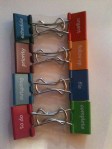
1. I tend to be a piler but piles take up a lot of space on my writing desk. Recently, I picked  up these binder clips at the clearance shelf of Staples.

(What writer doesn’t love office supplies?)
As I clean, I plan to clip these babies onto my piles and hang them on the wall with easy to remove hooks.

2. I find that my bulletin board gets covered in layers of paper. Strips of cork attached to the wall gives me space to hang plot charts and illustration sequences. 

3. I have a dedicated book shelf for books that I’ve borrowed from the library or from friends. That way the loaned books don’t get mixed in with my books. The library books move from the shelf in my office to a tote that I keep in my mudroom. This way, I can grab the bag and go. (Finding my kid’s library books is another question.)

4. I’m lucky to have a skinny but longish space for my office. I have a corner desk for my computer then I have another desk that I try to keep clean for journaling by hand, correspondence, bill paying, editing and revision. I still need to feel the pen in my hand from time to time.

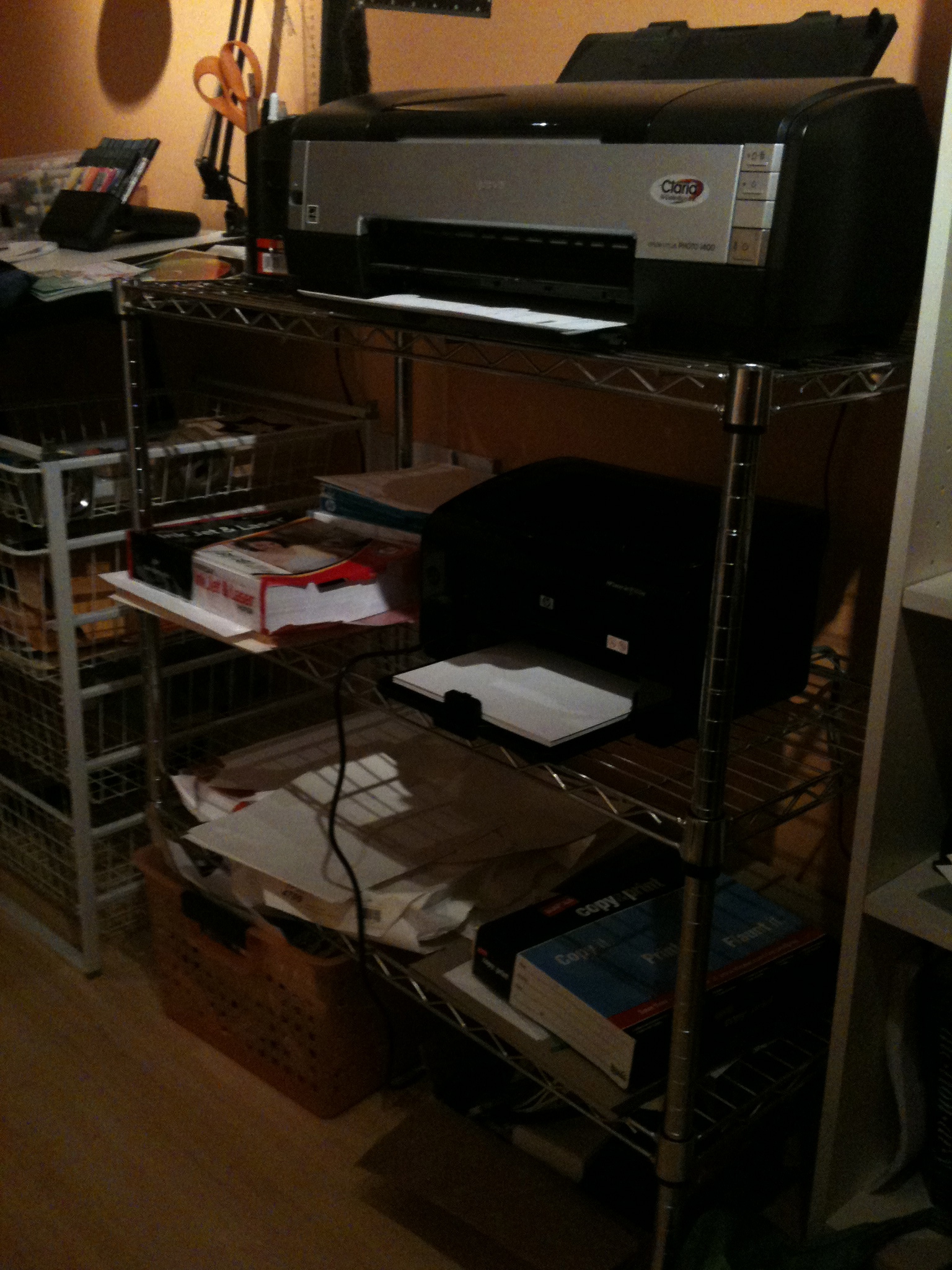
5. My printers are on a wire shelving unit that also holds my paper. I keep a recycling bin and ink and toner in bins under the unit. I can easily grab already printed paper for quick drafts so that I’m reducing paper use.

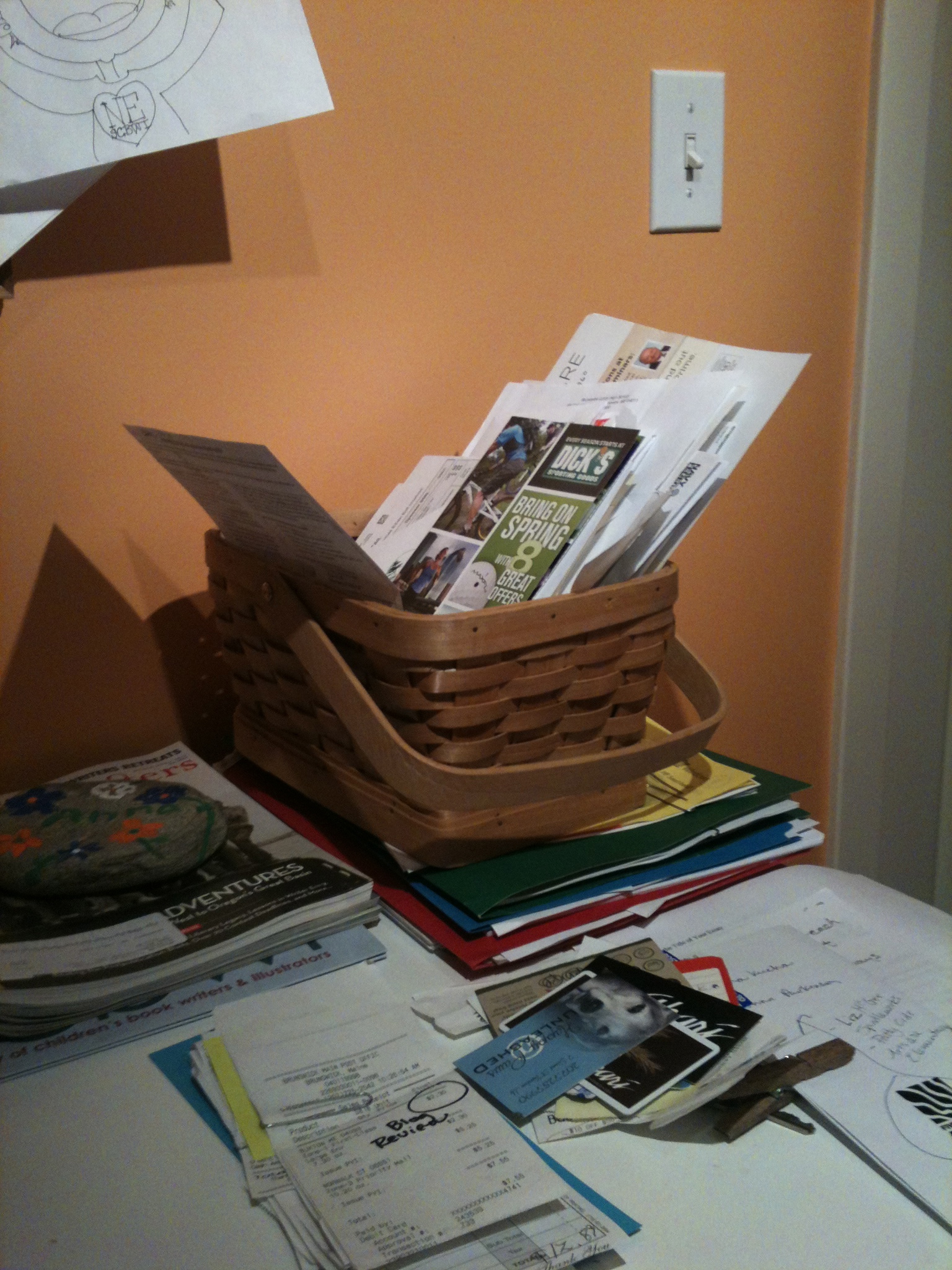
6. I have a basket on my writing desk that holds all of my bills. Twice a month I do as much as I can online then write checks. (Don’t ask me about taxes. My only advice there is hire an accountant. Best thing we ever did.)

7. My family teases me incessantly about my love of tote bags but they help keep me organized. In addition to the library tote, I also have a tote with the folders (my handouts and syllabus in one and a second for collecting work that needs to be graded) and books I need to take to the college class I teach.

8. When I’m at conferences, I tend to collect a lot of business cards and illustrator postcards. I try to write a little something to remind me of the interaction I had with each person then I slip them into plastic baseball card protectors. If I was really good, I’d have specific separate and divided sections of the binder for industry professionals (agents/editors), authors, illustrators, and other Regional Advisors.

9. Google Calendar is my lifesaver. I hardly do anything without checking the calendar and the fact that I can sync my iPhone and my calendar is a lifesaver. Each kid has his own color for his events, I have school calendar info on there, I even use it as an editorial calendar for my blog– noting book release dates and when I hope to post reviews.

10. I’ve never been able to keep my To Be Read list as well as I do with Goodreads. Again, I can access the list on the go, with the Goodreads App, when I’m at the library or indie book store. This helps with getting books that are on my list, as well as adding to my list. (And adding, and adding.)

Still, projects take over my life and my office, and I’m okay with that. There’s a sense of satisfaction in cleaning it all up and starting over again. Ahh… spring! What tips do you have to stay organized. Please share in the comments!

How are you?

I won’t lie. I like a little sympathy. Go ahead and give me a pat on the back, a hug, an invitation to dinner or lunch. If you are really feeling generous, ask to take my kids for a couple of hours, the day, a week. Whatever you do- don’t ask me how I am. The questioner can mean so many things that I have to wonder: Do you really want the answer?

Do you want to know the stats on my laundry pile, my dirty dishes, the volume of dog hair in the corners of the room? Do you want the low down on the cost of four new tires and two new sets of brakes? How bout my rant about the military system called DEERS which is supposed to keep track of the fact that my children and I exist and are entitled to health care but didn’t– so now I have to spend a day of my life trying to convince them that we do and that they should indeed pay for that ER trip a month ago.

Probably not. You want to know about my emotional state. Here’s the thing… if I stop running this crazy deployment race long enough to think about my emotional state, I will cry and I know you don’t want that.

Instead, I’ll tell you this:

  • My first triathlon is on April 15th. I’m training three days a week now, which is not enough but it’s what I can do.
  • Poem in Your Pocket Day is at the end of April, things are coming together but I’m finding it hard to get my tasks done so I feel as if I’m letting down the other organizers.
  • I’ve set a March 15th deadline for the revision of my WIP but I don’t think I’ll make that either.
  • Teaching is going well. My adult students turn in their first 500 word essay on Tuesday. If they come. If they do the work.
  • RA work takes a lot of time and would take a lot more if I could give it. I’m trying to pull together a couple of ideas for Northern New England for the summer. The conference is fast approaching.
  • I’m trying to figure out summer camp schedules so that both kids are away at the same time and I can get some respite.
  • With the help of the amazing people at AAA Northern New England, I’ve planned a two week trip to meet my husband in Florence and Tuscany in August.
  • The kids are definitely sad, but they are troopers like me. I see that more and more these days.
  • The swim season is over. Hallelujah! The drive and conflicting schedules between kids was a source of constant stress.
  • Baseball season is starting. Egads.
  • My children are wonderful musicians which is a source of constant pride.
  • We are all healthy and safe and that is what matters.
  • I saw my first robin yesterday and feel confident that spring will indeed come.

How are you?

Book Review Wednesday: Wonder by R.J. Palacio

WONDER (Random House)
by R.J. Palacio

As with most good stories, WONDER, R.J. Palacio’s debut novel for middle grade readers, begins on a day when something different happens. August’s mother asks him to try going to school.

A genetic anomaly, August (Auggie) Pullman was born with a facial deformity that required endless surgeries and kept him out of mainstream education. Auggie has experienced the cruelty of others in his Northern New Jersey neighborhood first hand (on the playground, at the ice cream store). Never the less, he agrees to attend the private Beecher Prep middle school.

The wondrous story of Auggie’s 5th grade year first includes all the friendship angst, cafeteria jockeying, educator’s wisdom, school projects, and field trips you’d expect in an odd-man-out, middle-school novel with two interesting exceptions.

First, Auggie’s physical appearance is pretty startling. Of course, the reader can’t see Auggie but that doesn’t matter. As Auggie states at the onset of the novel, “I won’t describe what I look like. Whatever you’re thinking, it’s probably worse.” Despite this, the reader falls in love with and roots for Auggie from the start. R.J. Palacio writes Auggie as smart, funny, unendingly patient with his new friends, incredibly forgiving of his family. He is more mature than all around him because he has learned from the mistakes of others and is a product of his loving and supportive family. Perhaps Auggie is too-good-to-be-true and he’s not the only one.

Dad makes everyone laugh, Mom takes care of everyone, older sister Via feels jealous of all the attention Auggie has gotten but then knows enough to feel guilty about it. Via’s new boyfriend gets the lead in the school play. Even Via’s out-of-favor best friend gives up something very important to her just to be generous. In other words, with the characters in WONDER, even their flaws are perfect.

Second, R. J. Palacio tells the story in alternating first person. Not only Auggie, but also his sister Vi, his new friends Summer, and Jack, and his sister’s best friend each have a hand in telling the story. Instead of each narrator moving the story forward, they each retell a preceding portion of the story and then move on. The benefit of this structure is that the reader sees Auggie from the perspective of those around him. However, this two steps forward, one step back pacing can be frustrating, especially when the new point of view doesn’t add enough new information to the replayed scenes.

R.J. Palacio writes a happily refreshing family in the Pullmans. Loving and kind, playful and supportive, this family is one with which many readers will identify. Middle grade and Young Adult readers are all too used to reading about families with dead-mothers, substance-addicted or absent fathers, and snarky siblings. The Pullmans are a welcomed change.

In all, WONDER is a positive addition to the literature about the disability experience. F.J. Palacio’s story of acceptance, friendship, and kindness will carry the reader through laughter and tears and open their eyes to a life where something different happens.

Member Monday: Kites Are Flying!

It’s the first Monday in March but it is certainly not kite flying weather in Maine. We’ve had two late snow falls and while I was eager for snow in December, now I’m ready for spring. There’s nothing like the SCBWI Golden Kite Announcements to give me that warm fuzzy feeling inside.

A huge congratulations to the winners: Ruta Sepetys, Between Shades of Gray; Candace Fleming, Amelia Lost: The Life and Disappearance of Amelia Earhart; Kate Messner, Over and Under the Snow; and (fellow Mainer) Melissa Sweet, Balloons Over Broadway.

“But that is not all,” said the Cat in the Hat…

Last Wednesday, the voting on the Crystal Kite nominations closed and this week– uour finalists were announced! To vote: SCBWI Members should sign in, go to their member home area, and follow the “what’s going on in my region,” link. Next click on the Crystal Kite tab on the far right. Votes are based purely on personal opinion and no campaigning of any kind is permitted. Votes close on March 16th.

Congratulations to the regional finalists for New England:

At The Sea Floor Cafe
Leslie Bulion
Peachtree Publishers

Red Sled
Lita Judge
Atheneum Books for Young Readers (Simon & Schuster)

Pearl
Jo Knowles
Henry Holt Books for Young Readers

Swirl by Swirl: Spirals in Nature
Beth Krommes
Houghton Mifflin Books for Children (Houghton Mifflin Harcourt)

Wink the Ninja Who Wanted to Nap
Julie Phillipps
Viking Children’s Books (Penguin Young Readers Group)

Island’s End
Padma Venkatraman
Penguin Group

Celebrating all these great books for kids lifts my spirits– a little like flying a kite on a warm spring day.

Five on Friday: Flurry and Snowe

1. This week has been weird political whirlwind that included the Maine Democratic Caucus, Republican Senator Snowe’s retirement announcement, a flurry of speculation regarding new candidates and a March 1st snow storm. I had collected a bunch of signatures for Chellie Pingree’s 1st District Congress seat and was then happy to learn that I should be prepared for another set of papers any time now. I’m crossing my fingers that she decides to run. At this writing, she has not confirmed or announced either way. Also pleased to say that the Blunt amendment was blocked.

2. I wish I could say that the snow day let me get a bunch of work done on my WIP. Sadly, no. Instead I caught up on my volunteer efforts for the Junior High Music Boosters, did laundry and watched a movie with my kiddos.

3. I am training in earnest again. My first tri of the season is in about 7 or so weeks. The Nor’Easter a backwards triathlon. I’ve started the multisport class at the Y and had a blast getting my butt kicked by our drill master instructor, Jen on Monday. If I don’t finish this blog soon I’m going to be late for the Friday class. Eek!

4. My second “Book Review Brigade” class (hosted by Maine Writers and Publishers) is tomorrow. I stayed up late working on four different book reviews for the class (adult fiction) and didn’t get to post my kidlit Book Review Wednesday. I apologize and will double up next Wednesday.

5. Two months officially down on this deployment and about 10 months to go. There are good days and bad days. The worst days have me screaming like a banshee. The best days  include small intimate moments with my children. Day by day, folks. Day by day.

Member Monday: Critique Groups in New England and Beyond, Part 2

Happy Monday Morning! I am slowly adjusting to the dry, cold and snowy weather that is  Maine (read: not Puerto Rico). I’m so glad that you are here to read Part 2 of my interview with NESCBWI Critique Coordinator, Stacy Mozer. If you missed Part 1, take a look here.

Today we talk about critique group conflicts, intellectual property, and setting structure norms. How does your crit group deal with these issues? What do you get from your writing pals? Join the discussion and leave a comment.

Hey Stacy, welcome back. Sometimes crit groups are made up of long-time friends and sometimes they are constructed of writers and illustrators who have just met. Either way, there are bound to be issues. What if a group is having problems with a member? Are you (as crit group coordinator) available to help? What types of problems do crit groups have?

Critique groups certainly can have issues with members. The best way I’ve seen it handled is to go back and review the group’s norms (which should be set up at the first meeting). If that doesn’t change a member’s behavior, the critque group leader needs to have an honest conversation with the member, which I am happy to help with either by coaching the leader or making the call. If things continue not to work, it is time to part ways.

Some people are reluctant to join a crit group because they are afraid someone will steal their ideas. What are your thoughts about crit groups, the SCBWI community, and intellectual property?

You have ownership of what you write, even if you don’t have a copyright on the work. If a member is still worried, set up email submissions. That gives the file a date stamp you can use if it should ever come to it.

I know that a crit group can ask important questions that make a manuscript tighter, but what other benefits do you hear about?

The critque group is your tribe, a group of people who are there to help you survive. Make sure to leave time during group meetings to share more than your work. It will help keep you going through the very slow process that is writing and publishing a book.

Is there a structure for reviewing work in an SCBWI crit group that is standard? What does it look like?

Each group needs to set up their own norms. Some like to submit work before, some like to bring it. Some critique into the circle, everyone talking when they have an idea. Others like to go around, giving each person a chance at critique. There really is no “one right way” to do it. It’s a good idea to take a step back every so often and review the group’s norms to determine which are working and which need to change. I also find it helpful to type up the group’s norms so that they can be reviewed later. One of my leaders sends new members the group’s norms before their first meeting.

What are the differences between online crit groups and in person groups? Structure, relationships, etc.

I don’t know if there is a good answer for this question every in person and online group is different. I can tell you that SCBWI is creating a new website which will make finding online groups much easier. They are hoping to have that up and running by the summer.

I know that our Illustrator Coordinator, Casey Girard is working on a new illustrator sharing blog. How many of the crit groups are for illustrators?

At this point we have few open illustrator groups. We do have illustrators that belong to picture book groups if they are author/illustrators. I would like to see this area grow in the future.

Thank you so much, Stacy. I wish you luck on your current WIP!

Your welcome, Anna. For more information, members can look at past NESCBWI News. I write a column each month that focuses on some area of critique groups.

SCBWI Members from any region can access the NESCBWI News by logging in to SCBWI.org going to the Regions tab>Regional Chapters> click on any New England State>Regional News and scroll down until you get to the PDF links.

Home Again Friday: Puerto Rico in Pictures and Poems

The last little piggie may have cried, “wee-wee” all the way home, but on our way home from Rincón, Puerto Rico my boys and I just cried. After an amazing week of surf, sand, sun, snorkel, and scuba, the last thing we wanted was to come back to the bare winter of Maine. There are no palm trees in Maine. More important, in Maine, we don’t have the attentive care of my parents who lavished us with food and fun.

Today, a slide show and two intimate-moment-Mama poems.

This slideshow requires JavaScript.

Our Son
by Anna J. Boll

gentle eyes,
easy smile,
gorilla arms,
fuzz on upper lip

in him
i see you,
frozen in photos,
boy to man

he catches me
staring,
shakes his head,
disowns
a crazy mother,
full of pride

Sunrise
by Anna J. Boll

House lights twinkle
on dark island hills.
Wind,
like maracas,
shakes palm fronds,
and chills the air

Long ago,
I wrapped two hands
around my big belly.
Now,
I wrap a blanket
around us both.

Coqui peep,
roosters crow,
dogs bark,
we wait.

We expect
purple,
fuschia,
and orange
to tint the clouds.

But the light
creeps.
The sky
blues.
No show stopping
performance.

Just you,
and me,
and a moment
together.