Member Monday: The Children’s Book Industry, A gendered affair

A disclaimer is always at the bottom of this blog but before today’s post I just want to make sure it’s seen:

Disclaimer: As always: Any opinions expressed here are entirely my own and not the views of the SCBWI. FMI http://www.scbwi.com

Phew. Done.

Yesterday, as you probably know, was Mother’s Day here in America. Google made a super-cute, animated logo that jumped to the Wikipedia explanation of the founding of Mother’s Day by Anna Jarvis in 1908. Earlier though, in 1870 at the end of the bloody Civil War, Julia Ward Howe called for a Mother’s Day in honor of Peace. She, who wrote the Battle Hymn of the Republic, also wrote the Mother’s Day Proclamation. In the spirit of activism and women– today’s post.

What does Mother’s Day have to do with the Children’s Book Industry? Well, I’d bet money that a lot more than 50% of my (small) readership is women. How do I know? Go to any SCBWI conference and check out the bathrooms. We always switch one men’s room to a woman’s room in order to handle the demand. It’s not only the writers either. A large number of the editors and other industry professionals are women too– strong, intelligent, wonderful women.

In the illustration department the numbers start to sway. More men tend to be illustrators we know. Of the 12 illustrators in the “Bookmakers Dozen” only three are women. 

Now think about the people you see keynoting at national SCBWI conferences. The folks we know have really made it. Often men. I have nothing against these strong, intelligent, wonderful, men and I have to say that the tide IS changing. At the last few big conferences I attended, the podium seemed much more balanced. Nevertheless, one might ask… no, I ask… Why is it that we have an industry that is primarily female but whose big money makers are mainly male.

I’ve talked to a lot of people about this and have stitched together some thoughts on the issue. Below are four mistakes that women often make and men often don’t. (Let me mention that I do all of these things, all the time.)

1. Women often give away, that for which they should be compensated.
Think of your calendar, or list of things to do. How many times have you scheduled volunteer activities? Certainly there is nothing wrong with that, but all of those duties (often in service to our children) take away from time that you might do the work.  Further, how many times do you go into classrooms, or libraries to do readings or writing workshops for free? How much do you give away your Children’s Writing/Illustrating/or Publishing expertise?

Tip: Some pro bono work helps us get quotes and recommendations for our blogs, and helps us market ourselves, but have some sort of rule about how many or what kind of visit you will do for free and when those are done, say no to free visits.

2. Women often settle for compensation that is below the market value.
Our work and our knowledge is worth something. What is it worth? That is harder to determine. Some of us are published in magazines, some have books, some have awards. The Graphic Artist Guild has a Pricing and Ethical Guidelines publication that pools payment info and organizes it according to job and region so that illustrators/graphic artist have a better idea about the going rate and therefore know what to charge. Alexis O’Neill has this PDF entitled “What do I charge?” at her School Visit Experts.com site. I think it would be interesting to have a survey of all SCBWI members about their visit and conference fees and to publish the results. Even if we knew what to charge though, women often settle for less. If you don’t believe me take a look at this book, or this book, or this article, or this one, or this one.

Tip: Do some research and ask people you respect how much they charge. I know, it’s scary. Ask anyway. Try to zero in on your worth and stick to it when a school starts telling you they don’t have any money. Research outside funding sources or grants that they could apply for in order to pay you your stated price. Ultimately, you are trying to sell books. Could they schedule a book signing event for the school where they contract with a local indie bookseller?  In terms of book contracts– get an agent. It used to be that those in the Children’s Industry didn’t need one. Those days are gone. Most publishing houses are closed to unagented manuscripts and the extra money you will get with an agent who knows editors and their contracts is significant.

3. Women often over-schedule outside events which leaves less time to do the work.
Anytime you are not writing, illustrating, sketching, revising, reading critically, you are not doing the work. Ultimately, your teaching or your school and conference visits depend on your publishing calendar. New books, mean new visits.

Tip: Be deliberate when scheduling visits. Budget out your year. Say to yourself, I want to make this much money from visits this year. I’ll need to do this many visits to make that happen. Try breaking your year into school visit season and writing season. You probably know your own work rhythms. Are you unproductive in January and February? Schedule all your travel and visits then.

4. Women have a lot they are responsible for and this keeps us from doing the work.
Many of us have a ton of domestic responsibilities. We drive children, do laundry, take care of our parents, and on, and on, and on. Ultimately, we will not get the book contracts if we don’t do the work. We can wait for another more favorable time (which may never come) or we can “write in the cracks,” a term I’m borrowing from Eileen Spinelli. Further, at-home loneliness often drives people (read: me) to social networking sites where we convince ourselves that we are building an online platform for the magical day when our book is purchased.

Tip: Value yourself and your work enough to get a babysitter, then run away and write or draw. If you have a spouse, negotiate time on your own and schedule it in the family calendar. Take a pen and notebook and write on the road. If your kid is in baseball practice, stay in the car and write or sketch. You don’t need a laptop and you especially don’t need the internet. If you are not published and that is your goal, I challenge you to find one hour each day when you are “building your online platform,” to do the work.

In closing– Value your time. Value your knowledge. Do the work. 

Five on Friday

1. A moment of wild rumpus for Maurice Sendak.

2. June 3, 2012, 7 pm, at University of New England, Portland campus, Taylor Mali, poet, performer and poetry slam winner will be reading. His poem “What Teachers Make,” went viral on YouTube a while ago and with the release of the poem in book form, it’s sure to start turning up again. Send it to your favorite teacher for Teacher Appreciation Week (May 7-11). Proceeds from the show go to help the Cobscook Community Learning Center. Also reading are Gary Lawless and Elizabeth Peavey. You can get ticket here.

3. This past weekend the family who lives on the Darthia Farm hosted the Maine Writers and Publishers Alliance writer’s retreat providing a safe place for the participants to learn more about their craft. On Monday morning the farm buildings, hay, and livestock were destroyed in a tragic fire. The effort to rebuild this  iconic Downeast Maine organic farmstead please click here.

4. The good news: Four months of deployment done. The bad news: This week has been particularly difficult with the rain. I couldn’t manage to find any motivation– not for exercise, not for revision. I’d say I need a swift kick in the pants but what I really need is a shake. It feels as if there is a cloud all around me that’s hard to push through. The good news: Instead I dove head first into historical fiction by Phillipa GregoryTwenty more pages of THE LADY OF THE RIVERS, then I’m coming up for air and revisions. The bad news: It turns out to be the first of a series and I might have to read the next one.

5. The good news: I’m starting to entertain thoughts about our trip to Florence and Tuscany to meet up with my husband.

Book Review Wednesday: Middle Grade Book Talk

Still I Read
by Anna J. Boll (with apologies to Ms. Angelou)

Baseballs slump on backstops
games unable to proceed
Worms drown on the blacktop
but still I read.

Yes, it seems that the only thing that I can find motivation for these rainy, rainy days is reading. If you  are looking for new books to place on the top of your TBR (too-be-read) pile, look no further than today’s Middle Grade Books. These brand new releases are sure to be a hit with savvy middle grade readers. First on the list is the ONE FOR THE MURPHY’S. (Happy Book Birthday, Linda Mullaly Hunt!)


Shop Indie Bookstores

Linda’s summary:

In the wake of heart-breaking betrayal, Carley Connors is thrust into foster care and left on the steps of the Murphys, a happy, bustling family.

Carley has thick walls and isn’t rattled easily, but this is a world she just doesn’t understand. A world that frightens her. So, she resists this side of life she’d believed did not exist with dinners around a table and a “zip your jacket, here’s your lunch” kind of mom.

However, with the help of her Broadway-obsessed and unpredictable friend, Toni, the Murphys do the impossible in showing Carley what it feels like to belong somewhere. But, when her mother wants her back, will she lose the only family that she has ever known?

My take:

Lynda Mullaly Hunt’s debut novel explores the conflicted feelings of Carley Connor as she leaves a dangerous home situation to join the foster care system and live with the Murphy family. Vaguely reminiscent of The Great Gilly Hopkins, Lynda Mullaly Hunt creates a story all her own with honest emotion and believable dialogue. Carley’s relationship with Foster Mom Julie Murphy is heartening and evolves beautifully.

For a sneak peak of the first chapter take a look on Linda’s website. (Growing book lovers tip: read this aloud to your middle grade students/kids. Who can resist a book after hearing the first chapter.)


Shop Indie Bookstores

SEE YOU AT HARRY’S also launched this week (Happy Book Birthday, Jo!). When I asked her agent about this book before the launch he said, “Bring your tissue box.” Jo Knowles (LESSONS FROM A DEAD GIRL, JUMPING OFF SWINGS) recently won the SCBWI Crystal Kite for her novel PEARL. Jo is a wonderful and giving writer. If you are a writer, don’t miss her blog with Monday Morning Warm ups.

From the Candlewick site:

Twelve-year-old Fern feels invisible. It seems as though everyone in her family has better things to do than pay attention to her: Mom (when she’s not meditating) helps Dad run the family restaurant; Sarah is taking a gap year after high school; and Holden pretends that Mom and Dad and everyone else doesn’t know he’s gay, even as he fends off bullies at school. Then there’s Charlie: three years old, a “surprise” baby, the center of everyone’s world. He’s devoted to Fern, but he’s annoying, too, always getting his way, always dirty, always commanding attention. If it wasn’t for Ran, Fern’s calm and positive best friend, there’d be nowhere to turn. Ran’s mantra, “All will be well,” is soothing in a way that nothing else seems to be. And when Ran says it, Fern can almost believe it’s true. But then tragedy strikes- and Fern feels not only more alone than ever, but also responsible for the accident that has wrenched her family apart. All will not be well. Or at least all will never be the same.

My take:

With SEE YOU AT HARRY’S, Jo Knowles has given us a book that rings with emotional truth. In another author’s hands, the themes of family, self-discovery, and grief could feel heavy-handed or didactic. This reader never felt manipulated. In contrast, Knowles reveals a pathway into a very real family of six, each character beautifully whole and fabulously flawed. The plot was surprising and full of tension.

So there you have it. Book Review Wednesday (on Thursday) and plenty to read. Remember to support you local indie bookstore!

Member Monday: Read, read, read!

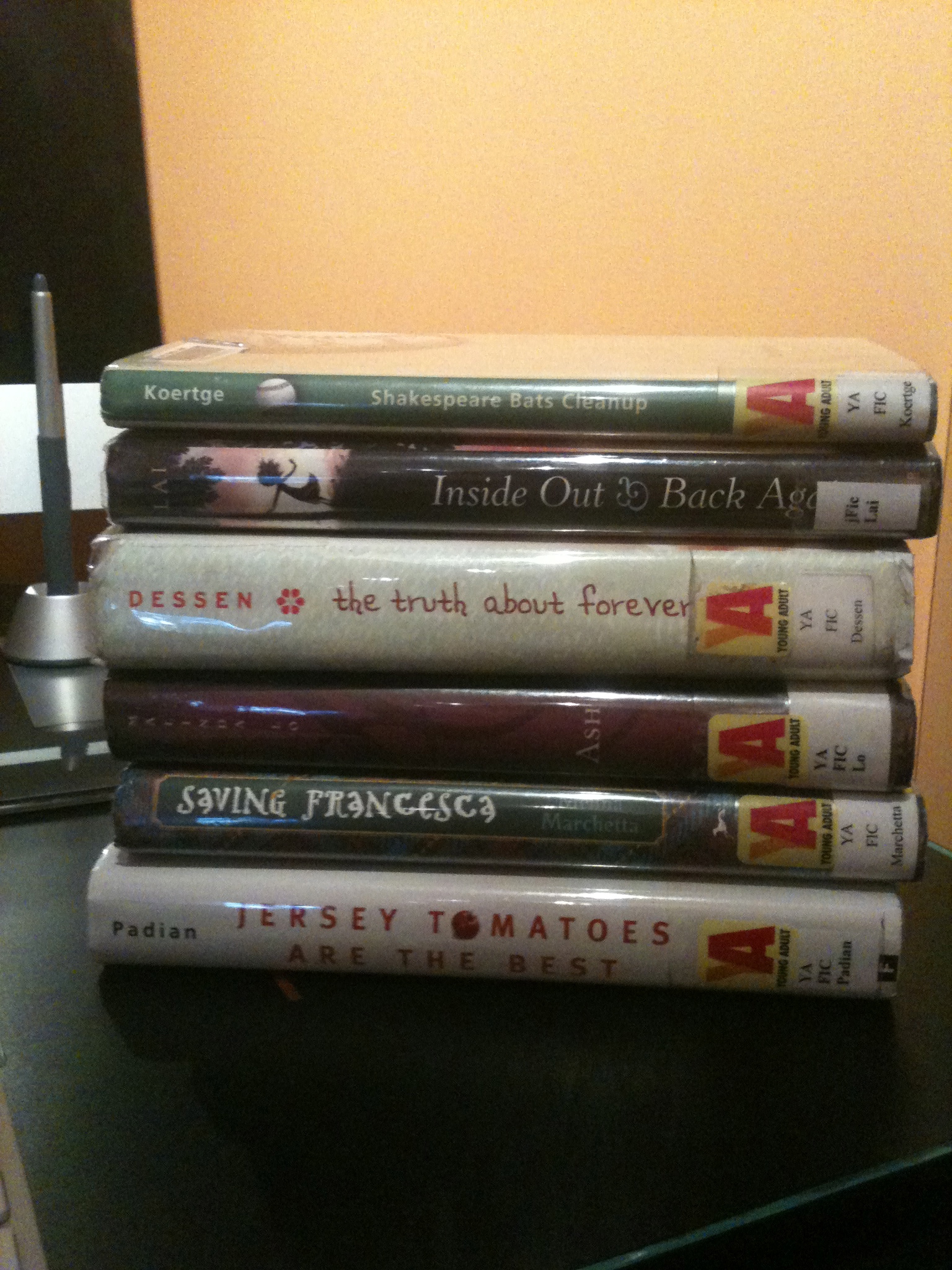
When the rain fell all last week, I holed up on the couch and read. When the sun came out, I dug the folding chair out of the garage, set it up in the sunshine and read. At the end of the day I felt a little guilty. There I was making dinner and I had limited writing or revising minutes to boast. In fact, I’d hardly done anything but read.

While I was in my MFA program, I didn’t feel guilty about reading. I was comfortable saying to my kids, “Mommy’s working.” I loved going to the library and coming home with a stack of books then reading them one after another or sometimes two at a time.

I know that reading is indeed part of my job. I need to know what books are on the market, and what books kids love. More important, I need to read critically. When I read, I’m constantly asking myself why. Why did the author make this word choice? How is the author going to weave these subplots together? When will this detail be relevant again and if it isn’t, why is it in the book at all? I question why a story doesn’t work and why it does. Good writers read.


Shop Indie Bookstores

Because I am such a critical reader, it is harder to find books that are pure escape but I love searching for them. Today, I pushed away my guilt, took my Goodreads App to the library, and took out a small pile of books.

Sure, I’m still revising but if you see me with my nose in a book, please do not disturb… I’m working.

Poetry Friday: Novels In Verse

I haven’t blogged this week. Partly because I was recovering from the events I organized for Poem in Your Pocket week, but partly because I’ve been sitting on this rather long post about Novels in Verse. I hope you’ll grab a cup of tea, stay awhile, and read. I’d love to hear your comments and opinions on this and really start a discussion about the verse novel structure.

Karen Hesse’s, OUT OF THE DUST (1997) was the first novel in verse that I read. The book, its structure and historical subject matter captivated me. Since then, the genre has exploded. Many kids like the novels in verse format because they are generally a faster read then a traditionally structured novel. The poetic structure of a verse novel can also make difficult or historic subjects more accessible. If you haven’t read many novels in verse, or verse novels you can find good lists of them here, here and here.

First, we should define verse. If one is writing “in verse,” there is some set rhythm or fixed metrical line to their poetry. [For example, iambic pentameter– or 5 iambs (2 syllables- soft-hard)]. Confusing the definition these days is that verse can also mean stanza or any poetry in general. This includes free verse, which has no “verse” or fixed rhythm at all.

Maybe part of my problem is that there is no real definition of what the verse novel structure needs to be. A sonnet, a haiku, a pantoum: all of these follow rules and I’m a rule follower. Let me be clear. I do not think that all novels in verse have to have a fixed or formal meter or rhyme scheme. I understand that there is a difference between a novel in verse and a collection of poems that tell a story. However, if a novel announces that it is in verse I do want to see the use of figurative language (metaphor, simile, onomatopoeia, hyperbole, etc.) and/or sound devices (assonance, consonance, and alliteration) in addition to line breaks.

Any dedicated author chooses each word after careful consideration and considerable hair pulling. She wants to be appreciated for the rhythmic quality of her words. She wants someone to say, “I never would have thought of that particular metaphor,”or “What a beautiful image,” or “This reads like poetry.” Yet even though some prose is poetic, not all novels work in verse.

When a novel in verse doesn’t work for me, I fight with myself. On one hand, I want to see kids exposed to poetry, and I think there are a variety of ways to tell a story well. On the other hand, I have questions about the legitimacy of the form. What makes a novel in verse? Is it enough for a writer to simply employ line breaks and call it poetry? What about figurative language, and formal poetic form? But wait, I counter, isn’t the line break a legitimate tool of the poet?

Many authors defend the form saying that line breaks are a valid poetic tool. The breaks allow the reader to fill in the space between what is written and what is implied. Absolutely! This is similar to the space between the panels in a graphic novel or comic strip. The reader creates, as Scott McCloud says, “closure” filling in the gaps between the frames. Holly Thompson, RA from SCBWI Japan and author of the verse novel ORCHARDS wrote in her Hatbooks Blog ,“In a verse novel all that white space needs to carry meaning.” (And I would add emotion.)

Here’s my problem, in too many “novels in verse,” I could easily get rid of the line breaks and the passage would read perfectly well. No space for the reader. No closure necessary.

One of my very favorite novels for children is, A CROOKED KIND OF PERFECT by Linda Urban. I listened to this book before I read it, (I highly recommend the audio version BTW) and I wondered, as I listened to the first few short, titled chapters, if Linda had written a novel in verse. It is poetic, and rhythmic. When I picked up the printed book I was pleased to see that she had written the book in prose but her language, emotion, and sensory details were so beautiful, honest, and specific that it read like poetry. I spoke to her at the recent NESCBWI conference and asked her if she had considered writing a novel in verse. She said no, but the novel in verse format gave her the liberty to consider a different format.

I shared an elevator ride with fellow poetry lover Kelly Fineman at the NESCBWI conference where we discussed the issue briefly. She’s done a number of interviews on her blog with authors of verse novels. Perhaps she’ll chime in here with an opinion.

Unfortunately, I’m ending where I started– with no real answers. However, since I’m considering this structure for one of my own WIP’s, I’ll continue to study the genre. What novels in verse do you love and why? What makes a novel in verse work, or not work for you? I’d love your thoughts in the comments below. 

Poem In Your Pocket 2012 Wrap-Up

This morning I opened my email to find this lovely note:

Thank  you very much for your good spirit and good work in the name of poetry this past week.  I missed the poem-in-your-pocket festivities on Thursday, but went to hear Wes McNair last night and enjoyed his readings and observations immensely.

What a joy to feel appreciated but a bigger joy still to have worked with co-organizers, Evie Katz, and Kathy Koerber, to bring something positive, and constructive to my community.

Throughout the week we brought poetry into the hearts and minds of over 100 neighbors.

Our events provided a stage and microphone for over 25 poets young and old, from those newly embracing the poetic form to professionals and professors.

This slideshow requires JavaScript.

Events in the schools and libraries served students in grades K-8 and the high school librarians created a beautiful bulletin board for Poem in Your Pocket Day. All these numbers resulted in countless smiles and new friends.

If you are interested in volunteering to help with next year’s festivities, please contact me. annajboll at gmail dot com

Poetry Friday: Wesley McNair in Brunswick, Maine tonight!

Tonight, Friday, April 27th, Wesley McNair, Maine’s Poet Laureate will read at the Curtis Memorial Library in Brunswick, Maine.

Recently, Wes sent me an email with the following vision of the event:

 I plan to tell the story of my life as a poet, using poems from my recent book, Lovers of the Lost, which is new & selected and so offers me this opportunity.

Wes has been a champion of poetry during his tenure as Poet Laureate. He edits a wonderful new weekly feature in the Portland Press Herald entitled Take Heart: A conversation in poetryHe appears around the state doing workshops and poetry readings, and has helped prepare high school students for the Poetry Out Loud competition. We are fortunate to have him.

I’m looking forward to meeting the kind man with whom I’ve been communicating, and the poet that I admire. I hope you’ll join me tonight at one of the final events of National Poetry Month.

Poem in Your Pocket Day!!!

If you didn’t already know, it’s Poem in Your Pocket Day. Since September, I’ve been working with two other community organizers, planning events, applying for grants, finding sponsors, designing posters and social networking around this fabulous, stupendous day!

Today I walked Maine Street in Brunswick with a bag of poem and stickers and handed them out to anyone who would take them. I visited the Little Dog Café, The Bohemian Coffee House, Frosty’s and Wild Oats. Some folks said they had heard about Poem in Your Pocket Day on the radio. Maybe this story. The smiles that I got in exchange for the poems made my day. My favorite interactions occurred when a few people told me they didn’t need one of my poems because they already had poems of their own! Listening to them read was lightness, and sunshine, and warm smiles.

One little girl with her Grandmother took my poem and sticker but the little girl was extremely shy. I left, walked the entire town then came back to my car. “Wait,” I heard. It was the Grandmother. “My granddaughter and I have been looking all over Brunswick for you. She wanted to give you this.” She handed me a poem that they had written out after I’d left. I think they made it up together. It made my day. Here it is:

Tulip
Tulip in the ground unplanted
We circle ’round and ’round
We wonder where it came from
Growing dizzy, falling down

TONIGHT, April 26th: Open Mic Night, 6:30-8:30, Curtis Memorial Library. Come read one poem. Yours or someone else’s. Must be family friendly. Sign-up when you arrive.

TOMORROW, April 27th: Reading by Wesley McNair, Maine’s Poet Laureate, 6:30-8:30, Curtis Memorial Library. Wes will have some books available for sale.

Poem in your pocket day will soon be gone. Quick, stuff your pocket with poems and share, share, share!

Member Monday: Post Conference Reminders and WHAT?! an event for illustrators!

It was an amazing weekend at the New England SCBWI Annual Conference jam packed with workshops, academies, portfolios, posters, speeches, networking, and fun! If you were there, and you blogged about the event, post a link in the comments below! Two big reminders for conference attendees:

1) Fill out your evaluation. The organizers and regional advisors look at all the data and really use it to make next year’s event even better. You can find the online eval here.

2) If you •attended the conference AND •live in Maine, NH, or VT you can write to me at NorthernNERA at nescbwi dog org to receive Submission Guidelines for the editors and agents who were there too. Please note: I do check your name against the conference roster as this is a conference benefit. I am a writer first and need to protect my work time, therefore I will respond to about 20 a day until I’m done so be patient. (If you live outside of Northern NE, write to your RA. If you are outside the region, write to Marilyn Salerno. Contact info here.)

TODAY, I’ve invited Renee Kurilla (@reneekurilla) to Creative Chaos to discuss an exciting event for NESCBWI illustrators at FableVision Studios in Boston, MA:

“Creative Juices Freshly Squeezed: A Visionary Art Show”
Friday, June 1st, 6-10 pm
308 Congress Street, Boston, MA

Casey Girard, our NESCBWI Illustrator Coordinator, and Renee worked together to create this meet up and they’d love you all to show up. Put the date on your calendar now. I’ll wait. No really, I know illustrators. If you’re an illustrator near Boston put it on your calendar now and add a couple of ringy-dingy vibrating reminders too.

Welcome, Renee! Tell us about FableVision and your position there.

FableVision was founded in 1996 with a mission of taking on projects that are not only meaningful and fun…but educational. My role at the company is Lead Artist, which means that I create characters, storyboard animations, design websites, books, etc. I often develop the “look and feel” for a project and work with a team to make sure my initial vision is carried through the project end. It’s fun…and challenging.

How are the Reynolds family involved in Fable Vision and how do they set the tone for the company?

Twin brothers, Peter H. Reynolds and Paul Reynolds are the pulse of the company. They make sure the work we do continues to be meaningful and full of impact. They maintain the morale of the studio, always adding life to any room they walk into. Personally, whenever I have hit a creative wall or need a critical eye, I can go to either of them for help and walk away feeling inspired.

We often create animated films from Peter’s books. Last year, our team animated The North Star and this year we will be working on a new film for his upcoming book, Sky Color. You can watch some of our films and game demos on YouTube: http://www.youtube.com/user/fablevision/featured

Little known fact: Paul Reynolds is our CEO and a very smart businessman, but he is also a very talented artist. That artistic ability and creative thinking runs in the Reynolds family through and through. 🙂

What is Creative Juices. A gallery? A blog? Both? How does it help employees and staff of the company? Tell us more.

Creative Juices started as a blog that was a place for anyone on our staff to contribute what they found inspirational. For a long time we shared articles about animations or new technology and wrote short essays about things that interested us.

Then, the art team decided a great way to keep our creative juices flowing was to initiate a drawing/creation challenge. Every two weeks, we would pick a new word and “illustrate” that word however we interpreted it. We called it “What the Doodle!?” (WTD for short)

You’ll see if you scroll through previous posts that not all of the entries were illustrations. Everyone at FableVision (Artists, Developers, Producers, and Writers) contributed something, and that is why we had a vision of a gallery show.

In 2010, we had our first Creative Juices Art Show and it was a huge success. In 2011, we also had a successful event! What makes it different from a regular gallery show is that we transform our working studio into a gallery space. We clean the walls, rearrange everything, hang track lighting and showcase the art that our staff makes in their free time. You won’t see any project work hanging, but we’d be happy to show you what we’re working on if you ask!

The current show is called “Freshly Squeezed” to pay homage to our very first blog post, by our Director of Art and Animation, Bob Flynn.

One year, our Technical Director, Brian Grossman created the most amazing software for making waffle art. I highly recommend checking out his blog post about it here: http://funfoodfight.blogspot.com/2010/04/art-of-waffle.html

We just recently brought back our “What the Doodle!?” Challenge after a brief hiatus and opened it up to the public. Check out our studio twitter for frequent updates: @FVStudioBoston The next due date is Friday April 27th and the chosen word is: OBSTRUCT (Just tweet at us to participate!)

We very much look forward to seeing what you all come up with!

What is the purpose of the NESCBWI partnership with FableVision?

It seems a very likely partnership to me! The idea for an event came from the NE Illustrator coordinator and good friend of mine, Casey Girard. Genius! We’re all storytellers and worlds are merging a little bit more than they used to – we definitely embrace that at FableVision. I think illustrators and writers should be more aware of the vast realm of possibilities in the industry. And even if you already are aware, it’s a great excuse to open our doors and let lots of talented people mingle! Sometimes all it takes is a conversation to inspire your next big project!

We also have three members of SCBWI in our midsts, myself, Peter H. Reynolds, and John Lechner. The three of us definitely know how amazingly awesome it is to be a part of the undying support system that is SCBWI.

How is FableVision on the cusp of publishing?

We have a very talented team with big ideas. We pay close attention to what’s current and also pay homage to what makes us nostalgic. Every single person on our staff is passionate about something whether it’s games, stories, children’s books, animation, or comics and we are always thinking of new ways to deliver a really fun experience. We also love projects that help us learn, whether it’s about american history or how to code an interactive app – with magic, of course!

Disclaimer: We don’t really use magic 🙂

What kinds of opportunities are available for NESCBWI illustrators with FableVision?

Most of our art team is made up of illustrators! You too could be an artist at FableVision!

How will the event for illustrators in Boston be structured?

We haven’t yet finalized all the details of the evening, but the primary goal is to create an informal space where members of SCBWI can mingle with FableVision staff. We’ll probably do a quick introduction of ourselves, but then mostly just have snacks, drinks, and conversations. It should be a really, really fun time.

What haven’t I asked you that you’d love to tell our members about?

Please check out our studio website, facebook page, blogs, and twitter page for updates on the event!
Here’s a list of all the places we’ll be posting:

fablevisionstudios.com/blog
fablefolk.blogspot.com
twitter.com/fvstudioboston
http://www.facebook.com/FableVisionStudios

Thanks so much for reading and to Anna for asking! We hope to see you on June 1st!

On the road to the NESCBWI conference: Part 3: Friendships

If you’ve been following my April break journey here, and here you’ll know that I was in New Jersey yesterday. I had a lovely time visiting Meg Wiviott, talking writing with my VCFA friends, and lunching with a friend from my DC days.

The drive to Springfield from NJ was bearable because he gave me CD’s from hilarious comedians. I listened for as long as they lasted– sadly not the entire three hour drive but they got me through a traffic jam when everyone was rubber necking at a non-accident.

The rest of the way, I was able to contemplate friendship and aging and other existential concepts. My friends are far flung. I’ve met them in summer camp and college, through volunteering and in Vermont. Some I’ve kept from the old DC neighborhood. My book club and writing friends have been in my life the longest.

Social networking sites have certainly helped me reconnect with many and  stay in touch with most but I often close out a session on Facebook feeling more lonely then I when I started checking everyone’s status. In my current situation, with hubby deployed, it is difficult to make the time to see people in person. This week I took the time to refuel with friends face to face. I laughed and hugged, and sipped tea with people who stimulate my mind, reflect my emotions, and give me the kick in the butt I need to keep going.

Today, I’ll be swamped with hugs and handshakes. There will be over 500 attendees at the Annual Spring NESCBWI Conference. To each, I extend the following challenge– meet five new people each day. You never know, that person sitting next to you at the keynote speech, may just be a new friend.

Hello, Springfield, Mass. We’ll be here all weekend!