Member Monday: Spring Cleaning

Perhaps it is because we lost an hour this weekend, but I’m only just getting to my computer today and it is 9:40 at night. I have to admit that when the sun comes out, and warms the Earth (it was 60 degrees here in Maine today) it becomes harder and harder to put butt in chair.

Nevertheless, we all have to move forward with our work despite the weather. Spring does put me in a clean up mode. This weekend I hosted my book club which resulted in an epic “sh*t-out” session. For the moment, I have clean kitchen counters that look like this…

Anything that stayed, got moved to my office though so now it’s time for some office organization. Whether you have an actual office space or desk in the corner of another room, it is good to have some sense of order, even if it is an order only you understand.

Here are ten quick tips to help you out with your spring cleaning whether you are a piler or a filer:

1. I tend to be a piler but piles take up a lot of space on my writing desk. Recently, I picked  up these binder clips at the clearance shelf of Staples.
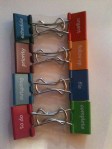
(What writer doesn’t love office supplies?)
As I clean, I plan to clip these babies onto my piles and hang them on the wall with easy to remove hooks.

2. I find that my bulletin board gets covered in layers of paper. Strips of cork attached to the wall gives me space to hang plot charts and illustration sequences. 

3. I have a dedicated book shelf for books that I’ve borrowed from the library or from friends. That way the loaned books don’t get mixed in with my books. The library books move from the shelf in my office to a tote that I keep in my mudroom. This way, I can grab the bag and go. (Finding my kid’s library books is another question.)

4. I’m lucky to have a skinny but longish space for my office. I have a corner desk for my computer then I have another desk that I try to keep clean for journaling by hand, correspondence, bill paying, editing and revision. I still need to feel the pen in my hand from time to time.

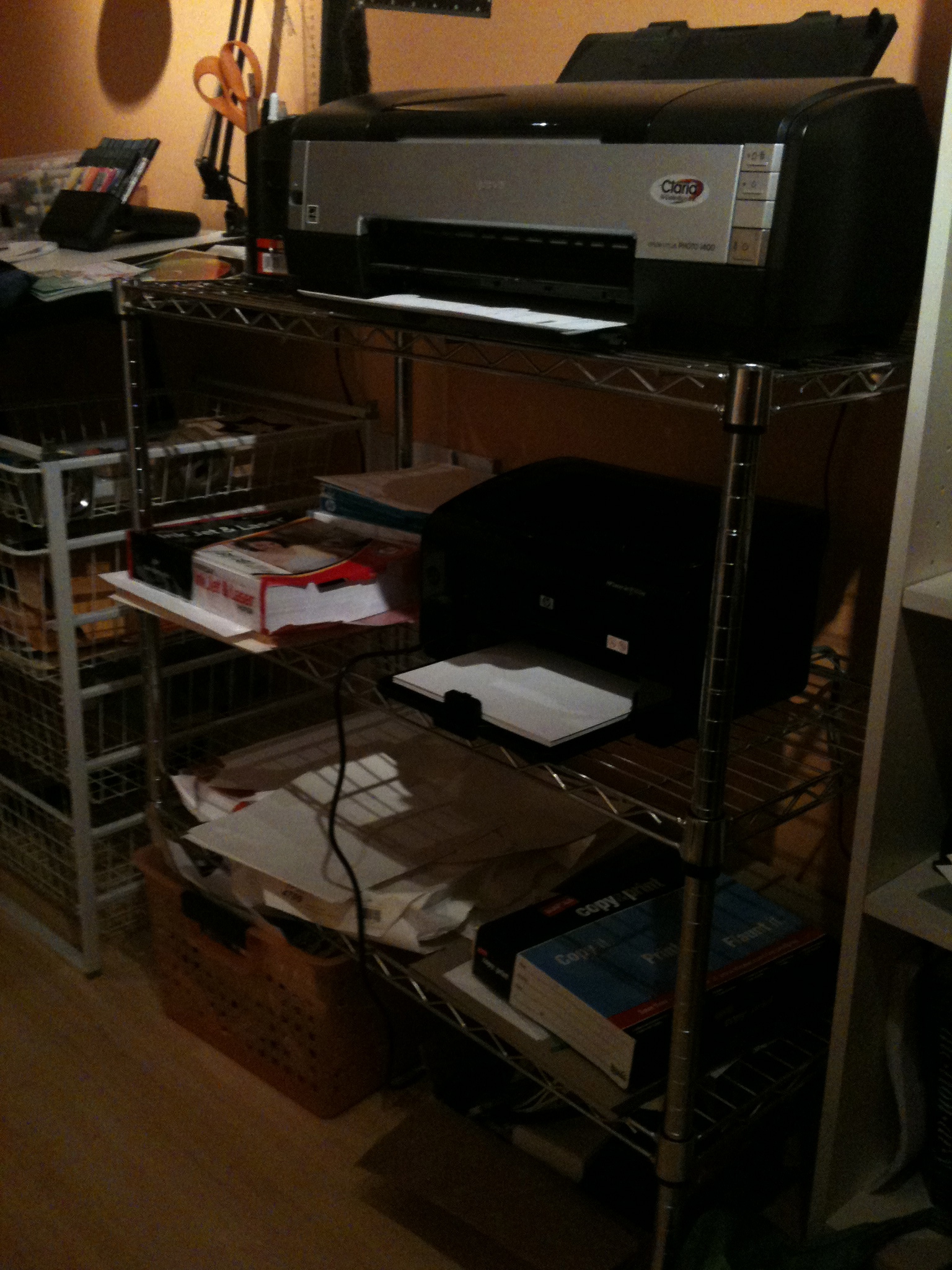
5. My printers are on a wire shelving unit that also holds my paper. I keep a recycling bin and ink and toner in bins under the unit. I can easily grab already printed paper for quick drafts so that I’m reducing paper use.
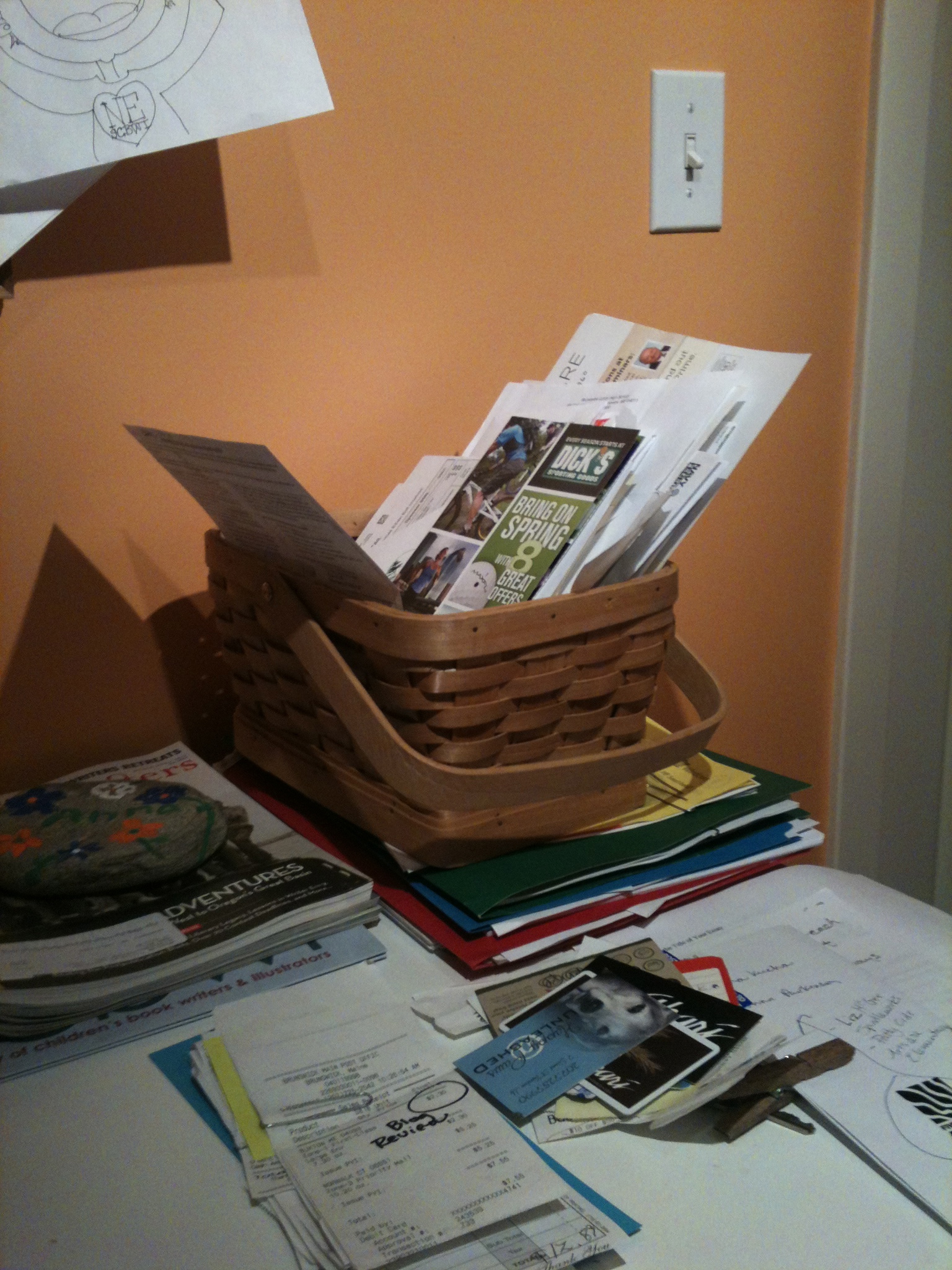
6. I have a basket on my writing desk that holds all of my bills. Twice a month I do as much as I can online then write checks. (Don’t ask me about taxes. My only advice there is hire an accountant. Best thing we ever did.)
7. My family teases me incessantly about my love of tote bags but they help keep me organized. In addition to the library tote, I also have a tote with the folders (my handouts and syllabus in one and a second for collecting work that needs to be graded) and books I need to take to the college class I teach.

8. When I’m at conferences, I tend to collect a lot of business cards and illustrator postcards. I try to write a little something to remind me of the interaction I had with each person then I slip them into plastic baseball card protectors. If I was really good, I’d have specific separate and divided sections of the binder for industry professionals (agents/editors), authors, illustrators, and other Regional Advisors.
9. Google Calendar is my lifesaver. I hardly do anything without checking the calendar and the fact that I can sync my iPhone and my calendar is a lifesaver. Each kid has his own color for his events, I have school calendar info on there, I even use it as an editorial calendar for my blog– noting book release dates and when I hope to post reviews.

10. I’ve never been able to keep my To Be Read list as well as I do with Goodreads. Again, I can access the list on the go, with the Goodreads App, when I’m at the library or indie book store. This helps with getting books that are on my list, as well as adding to my list. (And adding, and adding.)

Still, projects take over my life and my office, and I’m okay with that. There’s a sense of satisfaction in cleaning it all up and starting over again. Ahh… spring! What tips do you have to stay organized. Please share in the comments!

Member Monday: Kites Are Flying!

It’s the first Monday in March but it is certainly not kite flying weather in Maine. We’ve had two late snow falls and while I was eager for snow in December, now I’m ready for spring. There’s nothing like the SCBWI Golden Kite Announcements to give me that warm fuzzy feeling inside.

A huge congratulations to the winners: Ruta Sepetys, Between Shades of Gray; Candace Fleming, Amelia Lost: The Life and Disappearance of Amelia Earhart; Kate Messner, Over and Under the Snow; and (fellow Mainer) Melissa Sweet, Balloons Over Broadway.

“But that is not all,” said the Cat in the Hat…

Last Wednesday, the voting on the Crystal Kite nominations closed and this week– uour finalists were announced! To vote: SCBWI Members should sign in, go to their member home area, and follow the “what’s going on in my region,” link. Next click on the Crystal Kite tab on the far right. Votes are based purely on personal opinion and no campaigning of any kind is permitted. Votes close on March 16th.

Congratulations to the regional finalists for New England:

At The Sea Floor Cafe
Leslie Bulion
Peachtree Publishers

Red Sled
Lita Judge
Atheneum Books for Young Readers (Simon & Schuster)

Pearl
Jo Knowles
Henry Holt Books for Young Readers

Swirl by Swirl: Spirals in Nature
Beth Krommes
Houghton Mifflin Books for Children (Houghton Mifflin Harcourt)

Wink the Ninja Who Wanted to Nap
Julie Phillipps
Viking Children’s Books (Penguin Young Readers Group)

Island’s End
Padma Venkatraman
Penguin Group

Celebrating all these great books for kids lifts my spirits– a little like flying a kite on a warm spring day.

Member Monday: Critique Groups in New England and Beyond, Part 2

Happy Monday Morning! I am slowly adjusting to the dry, cold and snowy weather that is  Maine (read: not Puerto Rico). I’m so glad that you are here to read Part 2 of my interview with NESCBWI Critique Coordinator, Stacy Mozer. If you missed Part 1, take a look here.

Today we talk about critique group conflicts, intellectual property, and setting structure norms. How does your crit group deal with these issues? What do you get from your writing pals? Join the discussion and leave a comment.

Hey Stacy, welcome back. Sometimes crit groups are made up of long-time friends and sometimes they are constructed of writers and illustrators who have just met. Either way, there are bound to be issues. What if a group is having problems with a member? Are you (as crit group coordinator) available to help? What types of problems do crit groups have?

Critique groups certainly can have issues with members. The best way I’ve seen it handled is to go back and review the group’s norms (which should be set up at the first meeting). If that doesn’t change a member’s behavior, the critque group leader needs to have an honest conversation with the member, which I am happy to help with either by coaching the leader or making the call. If things continue not to work, it is time to part ways.

Some people are reluctant to join a crit group because they are afraid someone will steal their ideas. What are your thoughts about crit groups, the SCBWI community, and intellectual property?

You have ownership of what you write, even if you don’t have a copyright on the work. If a member is still worried, set up email submissions. That gives the file a date stamp you can use if it should ever come to it.

I know that a crit group can ask important questions that make a manuscript tighter, but what other benefits do you hear about?

The critque group is your tribe, a group of people who are there to help you survive. Make sure to leave time during group meetings to share more than your work. It will help keep you going through the very slow process that is writing and publishing a book.

Is there a structure for reviewing work in an SCBWI crit group that is standard? What does it look like?

Each group needs to set up their own norms. Some like to submit work before, some like to bring it. Some critique into the circle, everyone talking when they have an idea. Others like to go around, giving each person a chance at critique. There really is no “one right way” to do it. It’s a good idea to take a step back every so often and review the group’s norms to determine which are working and which need to change. I also find it helpful to type up the group’s norms so that they can be reviewed later. One of my leaders sends new members the group’s norms before their first meeting.

What are the differences between online crit groups and in person groups? Structure, relationships, etc.

I don’t know if there is a good answer for this question every in person and online group is different. I can tell you that SCBWI is creating a new website which will make finding online groups much easier. They are hoping to have that up and running by the summer.

I know that our Illustrator Coordinator, Casey Girard is working on a new illustrator sharing blog. How many of the crit groups are for illustrators?

At this point we have few open illustrator groups. We do have illustrators that belong to picture book groups if they are author/illustrators. I would like to see this area grow in the future.

Thank you so much, Stacy. I wish you luck on your current WIP!

Your welcome, Anna. For more information, members can look at past NESCBWI News. I write a column each month that focuses on some area of critique groups.

SCBWI Members from any region can access the NESCBWI News by logging in to SCBWI.org going to the Regions tab>Regional Chapters> click on any New England State>Regional News and scroll down until you get to the PDF links.

Member Monday: Critique Groups in New England and Beyond, Part 1

As the Northern New England Regional Advisor for SCBWI, I often get email queries that look a little like this one:

I am a new writer of children’s PB. I currently live in [My Town], NH, but am originally from [another state]. I recently completed my first PB manuscript. I am considering joining SCBWI, particularly because I need some assistance on publishing houses and/or agents to submit to. I would like to find local resources if possible. Can you tell me a little more about the regional chapter and the resources available?

As you can see, this very short email would require a very long response. I’ve answered a lot of these with:

Here’s my phone number, let’s talk. Please plan a 45 minute block of time for this phone call.

But more often, I send something that looks like this:

Welcome to the wonderful community of children’s books and SCBWI! The most important thing for that new manuscript is an audience of like-minded, knowledgeable writers. If you are an SCBWI member you can take advantage of our critique groups. Please take a look at the critique group site. http://nescbwicritiques.blogspot.com/ The groups are broken down by state. You’ll also find the contact for our critique group coordinator Stacy Mozer. She can help you with any questions you have about finding a group closer to you or starting a new group.

Today, I’ve invited Stacy Mozer to Creative Chaos to discuss the up’s, down’s and etiquette of critique groups.

Welcome Stacy! Can you give us a quick “state-of-crit-groups” in New England?

The state of our critique groups are constantly in flux. New groups open and close all the time. Some groups take particular interests. I’ve been working on ways to connect our groups and find our leaders. When people registered for the conference this year they could register as a critique group leader. We are inviting all leaders to a pizza party on Saturday night to say thank you and connect them.

If someone can’t find a critique group, how do they start a new one?

My first suggestion when someone contacts me is for them to use the member finder on SCBWI.org to see how many members live in their area. That can determine whether they want to start a local group or try something online. Either way, they should contact me at necritiquegroups@gmail.com.

Why is it so important for people to contact you?

I keep a list of members who are looking for critique groups and sometimes I can find new group members off that list. If there are members in the area, we next write a listing for Http://nescbwicritiques.blogspot.com. I also ask the new leader to join our Critique Group Leader Yahoo Group at http://groups.yahoo.com/group/CritGroupLeaders. I have made document files available to the crit group leaders through the listserve. These documents help give the leader ideas. The group is also a place where leaders can connect to each other and ask questions.

What do you think is the optimum size for a crit group, and why?

The size of the group depends on the needs of the members and the organizational skills of the leader. If the group is critiquing novels, I recommend no more than six because you need the time to read before the meeting and to review each one. A picture book group can vary in size because members usually bring the work with them and members don’t always submit every week. I have one amazing picture group leader who invites dozens of people each time. Usually only six show up to one meeting, but when she gets more she separates the group into different rooms in her house

That sounds great. How often do you suggest that crit groups meet?

I recommend no less than once a month. I do have some groups that meet weekly.

What if a group is having problems with a member? Are you available to help? What types of problems do crit groups have?

Critique groups certainly can have issues with members. The best way I’ve seen it handled is to go back and review the group’s norms (which should be set up at the first meeting). If that doesn’t change a member’s behavior, the critque group leader needs to have an honest conversation with the member, which I am happy to help with either by coaching the leader or making the call. If things continue not to work, it is time to part ways.

Please come back next Monday for Part 2 of my critique group interview with Stacy Mozer. We’ll discuss intellectual property concerns, structuring your critique group, illustration and online groups and more!

Member Monday: The importance of literacy

It may only be February 13th, but March and two wonderful literacy events, are right around the corner.

March 2nd is Dr. Seuss’s Birthday and the annual National Education Association’s celebration of Read Across America Day.

March 7th is World Read Aloud Day sponsored by LitWorld. SCBWI is an official partner of World Read Aloud Day and Headquarters is encouraging members to get involved. (See the other partners here. ) Both pre-published and published authors can play an important role in advancing literacy. It’s  a great opportunity for members to connect with your local independent bookstore and help promote the SCBWI’s role in literacy.

From the LitWorld website:
Literacy is the foundation for emotional and physical well-being, intellectual growth, and economic security. The right to read and write is a fundamental human right and belongs to all people.

Worldwide at least 793 million people remain illiterate. Two-thirds of them are women. All over the world, children are hungry for learning and for the power it brings. Research shows that children learn to read and write best by writing and telling the stories of their own experiences. Yet it is rare to find safe spaces where children feel fully comfortable to do so.”

It doesn’t matter if your event takes place on the 2nd or the 7th. What’s important is that we take a moment to think of how we can bring literacy to our communities.

What can you do?

  • Organize a read-a-thon with other authors/illustrators in your area. Perhaps a local independent bookstore would open for 24 hours to let people read all night long. Take donations and send them to a literacy organization.
  • Ask your local librarian if you can schedule free readings during library hours during the first week of March. Contact your SCBWI Regional Advisor to help you contact other authors/illustrators in your area.
  • Are you a well-known author with a well-read blog? Auction off a school visit for the first week of March with the procedes going to to a literacy organization.
  • Connect with LitWorld at litworld.org/worldreadalouddaychats to watch video chats and read alouds with special guest. Or do a read aloud video chat with someone far away.
  • Change your avatar on your social networking sites to support Read Across America and World Read Aloud Day.
  • If you live near NYC, attend a Books of Wonder/LitWord event.
  • Dress up as your favorite character.
  • Link to this blog, LitWorld, or NEA

There are more ideas, statistics, and classroom reproducables from LitWorld here.

Whatever you choose to do, don’t keep it to yourself. Both NEA and LitWorld have a place on their websites where you can register your activity. SCBWI members can send their photos and information directly to chelseamosser at scbwi dot org.


What’s new in New England SCBWI?

Unless you’ve had your head deep in your WIP you know that last night’s Super Bowl was  rematch of the Patriots vs. Giants Super Bowl from four years ago. Both times the New England Patriots lost in a dramatic, clock-ticking ending. I watched the game with my kiddos, my husband (on Skype chat in Africa), and my writer friends (in a separate window on twitter). Hubby went to shower at halftime, (It was about 3 am his time after all) and the writers heated up. Talk of the ads, the show (costumes, choreography), how Madonna looked at 53, her energy level, and the guest appearances kept me refreshing my screen every few seconds. The funniest part of the tweet show was when my writer friends disappeared to watch the PBS Masterpiece Theater period drama Downtown Abbey. Well, if you were a stalwart Patriot fan and stuck it through to the bloody end, I give you some New England SCBWI news and events to boost your spirits and keep you going through spring.

Live Animal Study: A Children’s Book Illustrator’s Workshop:

Sunday, February 26, 2012, 1:00 p.m. to 3:00 p.m.
The Edna Lawrence Nature Lab
13 Waterman Street, Providence, RI

Bring your sketchbooks, pencils, and light painting supplies and enjoy a rare opportunity to study a handful of live exotic (and some not-so-exotic) animals up close and personal!

RISPCA Humane Educator Laurelin Sitterly will present on each creature’s basic anatomy, movement, and habits that will be sure to inspire you and provide a wealth of knowledge for your animal-themed book projects. Taxidermy and skeletal models will also be available to examine, courtesy of RISD’s Edna Lawrence Nature Lab.

This is an event to gather inspiration from the animal world, practice your craft amidst an active environment, meet your fellow SCBWI illustrators, and benefit from a critique of your day’s efforts by your peers.

Registration Form

Must be completed and mailed to Christina Rodriguez, Workshop Coordinator by February 17, 2012
***Note: This program is for SCBWI members only. Not an SCBWI member? Join now!

Applications are now being accepted for the Ruth Landers Glass Writers Scholarship and the Ann Barrow Illustrators Scholarship:

Deadline for application: March 10, 2012.

Scholarship winners will receive one day’s free tuition for the 2013 New England SCBWI Spring Conference or any other NE SCBWI one-day event including Encore, Salon or other one-day workshop that we hold. The scholarship is for tuition only and does not cover any other expenses such as editor critiques, hotel or travel. Click for more information include rules and registration.

***Applicants MUST be registered for the 2012 New England SCBWI Spring Conference.
***Note: These scholarships are for SCBWI members only. Not an SCBWI member? Join now!

Working with a Book Marketing Consultant:

Saturday, March 10, 2012, 10:00 – 3:15
Eric Carle Museum of Picture Book Art
125 West Bay Road, Amherst, MA

Are you feeling unsure of your path after publication?
Do you wonder how best to handle the promotion of your book?

Many children’s book creators are supplementing their publisher’s book promotion efforts with the advice and tactics of marketing consultants.  Is this the right step for you?

Listen to authors and illustrators discuss their relationship and work with their marketing partners, Deborah Sloan and Kirsten Cappy. Then ask question of your own.

$15.00 for SCBWI members, $20.00 for non-SCBWI members
Registration fee includes admission to the museum.
No food or beverages provided. Please bring your own lunch and eat at the museum with other attendees.

And of course… The NESCBWI Annual Spring Conference:
Keeping it Real
April 20-22 in Springfield, MA

When last I checked there were still spots available for the conference but they are filling quickly so register today!

All of this information is also listed on the Chapter Home Page on the SCBWI.org website. Go to Regions>Regional Chapter and pick your state. In order to receive news and event information, and membership renewal emails, remember to keep your member profile up to date. Spring will be here before you know it!