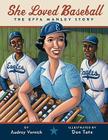
Book Review Wednesday: She Loved Baseball


Shop Indie Bookstores

The picture book biography is a great way to get kids interested in history. (Previous reviews of PB Biographies here and here.) A good PB biography author needs a hook– a place for a young reader to access the story. This entry point is often hard to find. Audrey Vernick found a great hook, a sister’s desire to play baseball with her brothers, in SHE LOVED BASEBALL: THE EFFA MANLEY STORY.

Effa’s principal discourages her from playing with her own brothers because their skin is dark and hers is light. This scene sets the reader up for the story of Effa’s tenacious resistance to the segregation and bigotry of 1930’s and 1940’s and her love of baseball.

Effa Manley became one of the great business women in the Negro League. She cared for her players in the Newark Eagles and was eventually respected by other owners in the league. Especially interesting to me was the fact that Negro League owners were not always paid for their contracted ball players when the players were finally accepted/hired by white teams. Effa changed that with a press campaign. Later, her letter writing campaign in the 1970’s to the National Baseball Hall of Fame started the induction of Negro League players. She was posthumously honored by the National Baseball Hall of Fame for her civil rights work and her work with the Negro Leagues.

Audrey Vernick’s text is well-suited to the picture book format. It is perfect for older elementary students researching on their own or for an adult read-aloud. The text and images are well-matched by illustrator Don Tate. Tate’s gestural figures and expressive faces pull in the reader into the historical period and the narrative.

Neither women’s history (March) or black history (February) need to be relegated to their  honorary months. SHE LOVED BASEBALL can be enjoyed year round.

Book Review Wednesday: Duck Sock Hop

There’s nothing I like better than getting a new book in the mail. Yesterday, I found this…


Shop Indie Bookstores

DUCK SOCK  HOP
Dial Books For Young Readers (2012)
By: Jane Kohuth
Illu: Jane Porter

I loved it so much I had to write about it right away.

Jane Kohuth engages readers and listeners alike on a variety of levels. First we get the  rhythmic text about ducks who like to wear socks and dance, with playful, spot-on, finger- snapping, toe-tapping rhyme. On second look, the parent reader can point out a variety of concepts: shapes, colors, opposites (right/left, high/low) numbers “three ducks boogie, one duck rocks. Two ducks stop and trade their socks.”

The wonderful thing about this book is that it is a perfect example of how a picture books can include a plot arc with a conflict. (This is something that I often have to mention in editorial situations.) After the ducks boogie and rock, they dance holes in their socks. Kohuth gives enough fun-loving time at the beginning of the story for the readers to fall in love with, and really care for the ducks, so we really feel sad when the dancing is interrupted. The change of mood also adds much needed change-up to the rhyme and rhythm. The adult-reader gets a chance to involve the child listener, “What are the ducks going to do?” The solution– Band-Aids and snacks, make ducks infinitely relatable to the toddler set.

Debut illustrator Jane Porter places the brightly colored ducks on fields of white. In the following video she describes her process. She draws using india ink and often uses a stick as her drawing tool.  Readers of DUCK SOCK HOP can feel the dance-y movement in the gestural quality of her drawing. Next, she layers on color and texture digital. In this book, the duck feathers and the sock details both have a wonderful print feel.

Jane Porter Interview

If your kiddo liked…


Shop Indie Bookstores

or…

Shop Indie Bookstores

They’ll love DUCK SOCK HOP!

Book Review Wednesday: At the bookfair.

Well friends, Creative Chaos finally broke the 100 views mark on Monday’s post, The Children’s Book Industry, a gendered affair.  Feel free to keep commenting there about your thoughts and ideas regarding the issue. It is obviously on the minds of many and also obvious that while valuing ourselves and our work is important, we can only go so far when limited by societal structures, budgetary constraints, and national policy that doesn’t support women, children, and families. Vote your interests.

TODAY… The Bookfair!

This week the Scholastic Bookfair visited my child’s elementary school and I volunteered. Yes, I know– therefore taking four hours away from my writing. However, I was able to watch kids and books and that is an eye-opening experience.

What they wanted:
It is true that many of them had five dollars or less and were gung ho to skip the books all together for a chance to purchase a pencil with the animal toppers that bug out their eyes when you squeeze. (huge hit) Diaries with locks for boys and girls also got a lot of touch time.

The money limit meant that they had to skip new releases. The big winners were mass market titles such as tie-in books Star Wars and anything lego was big with guys. Selina Gomez and iCarly, and Bad Kitty with girls. Ellen Miles has a series called Puppy Place that 2nd and 3rd grade girls tended to gravitate towards. The covers are super cute as was the book Little Pink Puppy about a piglet raised by a dachshund.


Shop Indie Bookstores

The Titanic was represented at the Fair but I didn’t see a lot of kids gravitate towards it.

I did get asked for the Hunger Games more than a handful of times but since this was an elementary fair it wasn’t present. Sort of surprised since Allie Condie’s, Matched series, Legend, and the Patterson Witch & Wizard books were all on hand. 

Overall, the kids were asking for adventure, and animals. Can’t be more succinct than that.

My favorites from the fair:


Shop Indie Bookstores

From Indiebound: Caroline lives on Meadowview Street. But where’s the meadow? Where’s the view? There’s nothing growing in her front yard except grass. Then she spots a flower and a butterfly and a bird and Caroline realizes that with her help, maybe Meadowview Street can have a meadow after all.

My take: On Meadowview Street, by Henry Cole, is a quiet picture book about the beauty around us when we appreciate nature and don’t try to control it. This PB was a bargain at $2.50 at the fair.


Shop Indie Bookstores

From Indiebound: Ivan is an easygoing gorilla. Living at the Exit 8 Big Top Mall and Video Arcade, he has grown accustomed to humans watching him through the glass walls of his domain. He rarely misses his life in the jungle. In fact, he hardly ever thinks about it at all.

Instead, Ivan thinks about TV shows he’s seen and about his friends Stella, an elderly elephant, and Bob, a stray dog. But mostly Ivan thinks about art and how to capture the taste of a mango or the sound of leaves with color and a well-placed line.

Then he meets Ruby, a baby elephant taken from her family, and she makes Ivan see their home—and his own art—through new eyes. When Ruby arrives, change comes with her, and it’s up to Ivan to make it a change for the better.

Katherine Applegate blends humor and poignancy to create Ivan’s unforgettable first-person narration in a story of friendship, art, and hope.

My Take: The One and Only Ivan, by Katherine Applegate (yes the Animorphs author) is told from the point of view of Ivan, a silver back gorilla. This makes for a visually interesting book with short sentences and paragraphs. Readable and well-designed.


Shop Indie Bookstores

From Indiebound: A reality-bending adventure from a Newbery Honor-winning author. Siblings India, Finn, and Mouse are stunned when their mom tells them they are flying that night–without her–to their Uncle Red’s home in Colorado. But things take an even more dramatic turn when their plane lands in a very unusual place. A mysterious driver meets them at the airport; when he drops them off at their “destination,” each kid suddenly has a clock with a different amount of time left. If the time runs out, they have to become permanent citizens in a place they don’t recognize or understand. Only if they work together can they call the driver back to help get them where they really belong. Suspenseful, funny, dramatic, and thought-provoking, this is a book that will stay with you long after you read the incredible ending.

My Take: Gennifer Choldenko brought us AL CAPONE DOES MY SHIRTS and its sequel AL CAPONE SHINES MY SHOES. My boys and I were riveted by her storytelling in those books. NO PASSENGERS BEYOND THIS POINT was on the Spring 2011 Indiebound NEXT list.

Enjoy your reading!

Book Review Wednesday: Middle Grade Book Talk

Still I Read
by Anna J. Boll (with apologies to Ms. Angelou)

Baseballs slump on backstops
games unable to proceed
Worms drown on the blacktop
but still I read.

Yes, it seems that the only thing that I can find motivation for these rainy, rainy days is reading. If you  are looking for new books to place on the top of your TBR (too-be-read) pile, look no further than today’s Middle Grade Books. These brand new releases are sure to be a hit with savvy middle grade readers. First on the list is the ONE FOR THE MURPHY’S. (Happy Book Birthday, Linda Mullaly Hunt!)


Shop Indie Bookstores

Linda’s summary:

In the wake of heart-breaking betrayal, Carley Connors is thrust into foster care and left on the steps of the Murphys, a happy, bustling family.

Carley has thick walls and isn’t rattled easily, but this is a world she just doesn’t understand. A world that frightens her. So, she resists this side of life she’d believed did not exist with dinners around a table and a “zip your jacket, here’s your lunch” kind of mom.

However, with the help of her Broadway-obsessed and unpredictable friend, Toni, the Murphys do the impossible in showing Carley what it feels like to belong somewhere. But, when her mother wants her back, will she lose the only family that she has ever known?

My take:

Lynda Mullaly Hunt’s debut novel explores the conflicted feelings of Carley Connor as she leaves a dangerous home situation to join the foster care system and live with the Murphy family. Vaguely reminiscent of The Great Gilly Hopkins, Lynda Mullaly Hunt creates a story all her own with honest emotion and believable dialogue. Carley’s relationship with Foster Mom Julie Murphy is heartening and evolves beautifully.

For a sneak peak of the first chapter take a look on Linda’s website. (Growing book lovers tip: read this aloud to your middle grade students/kids. Who can resist a book after hearing the first chapter.)


Shop Indie Bookstores

SEE YOU AT HARRY’S also launched this week (Happy Book Birthday, Jo!). When I asked her agent about this book before the launch he said, “Bring your tissue box.” Jo Knowles (LESSONS FROM A DEAD GIRL, JUMPING OFF SWINGS) recently won the SCBWI Crystal Kite for her novel PEARL. Jo is a wonderful and giving writer. If you are a writer, don’t miss her blog with Monday Morning Warm ups.

From the Candlewick site:

Twelve-year-old Fern feels invisible. It seems as though everyone in her family has better things to do than pay attention to her: Mom (when she’s not meditating) helps Dad run the family restaurant; Sarah is taking a gap year after high school; and Holden pretends that Mom and Dad and everyone else doesn’t know he’s gay, even as he fends off bullies at school. Then there’s Charlie: three years old, a “surprise” baby, the center of everyone’s world. He’s devoted to Fern, but he’s annoying, too, always getting his way, always dirty, always commanding attention. If it wasn’t for Ran, Fern’s calm and positive best friend, there’d be nowhere to turn. Ran’s mantra, “All will be well,” is soothing in a way that nothing else seems to be. And when Ran says it, Fern can almost believe it’s true. But then tragedy strikes- and Fern feels not only more alone than ever, but also responsible for the accident that has wrenched her family apart. All will not be well. Or at least all will never be the same.

My take:

With SEE YOU AT HARRY’S, Jo Knowles has given us a book that rings with emotional truth. In another author’s hands, the themes of family, self-discovery, and grief could feel heavy-handed or didactic. This reader never felt manipulated. In contrast, Knowles reveals a pathway into a very real family of six, each character beautifully whole and fabulously flawed. The plot was surprising and full of tension.

So there you have it. Book Review Wednesday (on Thursday) and plenty to read. Remember to support you local indie bookstore!

Book Review Wednesday: A Wreath for Emmett Till

Recently,  the name Emmett Till has surfaced quite a bit in relation to the  Trayvon Martin case in Florida. Houghton Mifflin’s teacher guide to A WREATH FOR EMMETT TILL gives the following short explanation of Emmet Till’s death.

Emmett Till was a fourteen-year-old African American boy murdered in 1955 in Mississippi for allegedly whistling at or speaking to a white woman. Though two men were tried for the crime, they were acquitted; no one has been convicted for Emmett’s murder. In 2004 the U.S. Justice Department reopened the case based on new evidence brought to light by two documentary films.


Shop Indie Bookstores

Marilyn Nelson’s  A WREATH FOR EMMETT TILL is a heroic crown of sonnets– a sequence of fifteen interlinked sonnets, in which the last one is made up of the first lines of the preceding fourteen. The final poem is also an acrostic that reads RIP Emmett L Till.

The book was published in 2005 and won the 2005 Boston Globe—Horn Book Award, a 2006 Coretta Scott King Honor Book, a 2006 Michael L. Printz Honor Book, and a 2006 Lee Bennett Hopkins Poetry Award Honor Book. Nelson is not a stranger to awards and prizes and holds three Coretta Scott King honors for her books EMMETT TILL, FORTUNE’S BONES, and CARVER and the Newbery Honor for CARVER: A LIFE IN POEMS.

With all of these awards, my opinion is unnecessary. Instead, this posting is a way to alert those of you interested in poetry and social justice about this sophisticated, complicated, and emotional book of poems.

I mentioned in a comment last Wednesday that we learn and retain new information when we have a scaffolding of previous learning upon which to hang the new knowledge. To this end, EMMETT TILL came across my desk at just the right time. I happen to be completing my first reading of TO KILL A MOCKINGBIRD. The classic courtroom and coming of age novel transported me to the deep south in 1935. While writing this post I also found out about “Strange Fruit” the 1936 poem about lynching referenced in EMMETT TILL. That poem was published by Abel Merrapol and made popular by Billie Holliday.

It is the season of Easter and martyrs, death and rebirth. Further, it is the season of Passover. I spent this afternoon teaching children about the importance of remembering  history so we will not be doomed to repeat our mistakes. Each year, Jews try to put themselves ourselves in that place of slavery, and deliverance so that they we will not allow slavery and injustice to happen again. But injustice is all around– in far away lands and close to home.

The poems of Marilyn Nelson remind us of this. Below is the fifth stanza, and I’m taken with how it captures my feelings for Trayvon Martin’s parents.

Your only child, a body thrown to bloat,
mother of sorrows, of justice denied.
Surely you must have thought of suicide,
seeing his gray flesh, chains around his throat.
Surely you didn’t know you would devote
the rest of your changed life to dignified
public remembrance of how Emmett died,
innocence slaughtered by the hands of hate.
If sudden loving light proclaimed you blest
would you bow your head in humility,
your healed heart overflow with gratitude?
Would you say yes, like the mother of Christ?
Or would you say no to your destiny,
mother of a boy martyr, if you could?

This book crossed my path at the exact right time.

While researching this post, I found a video of an hour long speech/reading that Ms. Nelson presented at Politics and Prose in Washington, DC. The section of the video on this book starts around 15:00-34:00 and she discusses the heroic crown of sonnets structure and the final acrostic poem. She also reads the entire book in the most melliflulous voice.

If you are interested in more information about Ms. Nelson, please follow the links to some of these other online resources.

There is an NPR interview with Nelson who was the Connecticut Poet Laureate at the time.

More about Marilyn Nelson at the Poetry Foundation here.

And a ton of links at Teaching Books including slide shows, videos, and other websites.

Book Review Wednesday: Citizen Scientists

CITIZEN SCIENTIST: BE A PART OF SCIENTIFIC DISCOVERY FROM YOUR OWN BACKYARD
By Loree Griffin Burns
Henry Holt and Company, 80 pages
ISBN 9780805090628

Some books make me want to stand on a chair in the middle of my local independent book store and shout, “You have got to get your kid this book!” It is rare that a nonfiction book would ignite this kind of passion but CITIZEN SCIENTIST: BE A PART OF SCIENTIFIC DISCOVERY FROM YOUR OWN BACKYARD is rare. Loree Griffin Burns manages to offer so much in a single volume that the book itself becomes a discovery.


Shop Indie Bookstores

The first discovery comes in the form of citizen science projects. The book is a year-long journey of four such projects– one for each season. The book begins in the autumn with monarch butterfly tagging, moves into bird counting in the winter, frog counting in the spring, and ladybug counting in the summer.

Each section is further divided and starts with a 2nd person narrative nonfiction explanation of the project. The use of the 2nd person places the reader smack dab in the moment of discovery. Keep reading and find out more about the science behind the project. Meet the scientists who oversee the projects and get a sneak peak at their instruments and labs. Next, meet actual young citizen scientist who are making a difference in the study of the featured organisms. Burns includes a check list to help children prepare for their study of the natural world, a quiz to check reader knowledge, diagrams of each critter, maps, and fabulous photos with thoughtful captions. The back matter includes a glossary, an index, and a resource page of field guides, internet resources, and other citizen science projects. (Imagine me breathless on my chair. I am.)

Since all learning is connected, readers get a dose of geography (migration paths) and economics (families who are paid for finding monarch tags in the central Mexican mountains where they live) with their science. Like the best educators, Loree Griffin Burns’ unique voice is comforting and empowering. She inspires children and their families to “contribute to understanding and improving our world.” Civics too!

This is one of the most thoughtfully designed nonfiction books that I’ve seen. Each season/project is color coded. The designer uses halftones of that color as the background for the 2nd person narrative then continues the section with white background and a ribbon edge of a matching hue. A reader can easily turn to the season they want by looking at the edges of the closed book. The fonts are playful and unique and carefully chosen elements set off the page numbers.

I would be remiss if I didn’t also mention the clear and well-composed photographs by Ellen Harasimowicz. The photos work so seemlessly with the text that there is a wonderful sense of balance between the writing, photos, and design.

With this book, Loree Griffin Burns relates the excitement and wonder of earnest observation of our natural world. She quotes Dr. Orley “Chip” Taylor who oversees the printing, distribution, and recovery of monarch butterfly tags, “If you are interested in conserving a particular organism you have to understand it. You have to understand every little aspect of its biology.” In CITIZEN SCIENTIST, Burns has managed to put together a well-researched and wonderfully written book that invites action on the part of all young citizen scientist.

Okay. I’m getting of the chair and putting it away.

Book Review Wednesday: Olivia Bean, Trivia Queen


Shop Indie Bookstores

OLIVIA BEAN, TRIVIA QUEEN
Delacorte Books for Young Readers
March 13, 2012, 288 Pages
ISBN: 978-0385740524

Donna Gephart won the 2009 SCBWI Sid Fleischman Humor award for her debut novel AS IF BEING 12-3/4 ISN’T BAD ENOUGH, MY MOTHER IS RUNNING FOR PRESIDENT! In OLIVIA BEAN TRIVIA QUEEN, Gephart’s third novel, the author known for her humor does not disappoint.

Olivia Bean has some very clear cut goals. She wants to be better at geography. She wants her father’s approval. She wants a friend. Olivia is sure that the path to her goals is to be a contestant on kid’s week of the game show Jeopardy!. This course of action is not far fetched. All the Bean’s are trivia crazy from Olivia, to her kindergarten brother Charlie, to her absent father. In fact, the bits of trivia that pop up throughout Olivia’s day successfully develop her character and keep the story moving forward.

Gephart creates many true-to-life characters who are full of faults. Perhaps the most flawed is Olivia’s father. An obsessive card player and gambler, he left Olivia’s mother and moved West with Olivia’s best friend’s mother. Just this is enough to turn a reader’s stomach, but Gephart doesn’t stop there. This father schedules calls with his kids and doesn’t follow through. He brushes Olivia off when she needs his support, and he shames her about the challenges she has with geography. Still, Olivia loves him.

Charlie, a five year old who hardly remembers his father, is just as enamored of trivia as Olivia but he prefers the gross variety. If you want to know how many bacteria there are in a square inch of armpit, or why a flamingo pees on its own leg, Charlie Bean can tell you that. Charlie is a constant source of comic relief in this sometimes very serious story. Gephart writes kindergarteners well and the dialogue between Charlie and Olivia is authentic, funny, and often heart warming.

Olivia lives with her journalist mother and almost step-dad Neil. While both are supportive and attentive, Olivia misses her father. She also misses being her mother’s confidant– a relationship that often occurs between a single parent and the oldest child. As the family faces money issues, Olivia matures and comes to terms with the fact that Neil is Mom’s new main source of support.

The book is written in first person present tense. This point of view transmits a sense of urgency– not only the reader, but also the narrator, is unaware of what comes next. Sometimes, the present tense can seem self-conscious and jars the reader out of the story. This was the case in OLIVIA BEAN. The benefit of this technique is that neither readers nor Olivia know if she will make it onto or win Jeopardy!. However, a past tense telling would have been just as exciting and more in keeping with the middle grade genre.

There are subtle chuckles tucked throughout OLIVIA BEAN TRIVIA QUEEN as well as a few laugh out loud moments. In this fast paced story for middle graders, the humor is a successful vehicle for more serious and skillfully handled coming of age issues.

Book Review Wednesday: The Girl Who Could Silence The Wind


Shop Indie Bookstores

Sonia Ocampo’s birth coincided with a terrible storm, but as soon as she was born, the winds went away leaving her family and the village to believe that she had a direct line to God. Her miraculous ability to silence the wind is both her blessing and her curse. In “The Girl Who Could Silence the Wind,” as in her middle grade novel, “Milagros” (Candlewick, 2008), Meg Medina, who has written for adults and children for 15 years, explores the power and pitfalls of the miracle.

At sixteen, Sonia has taken on the maladies, prayers, and dreams of the entire village. She is weighed down by milagros (tiny hand-forged prayer charms) which she wears on a shawl. While many people in Sonia’s fictional mining village make the journey North to pursue economic opportunity, Sonia is the anchor of faith for the village and is unable to explore her own dreams.

Sonia’s village might be in Mexico or Central America but the reader is often unsure. With lyrical writing, Medina creates a fictional world which skirts the edges of reality and magic. The reader is covered in the dust of the mountains, he can hear the promising whistle of the train that runs to the capital, and feel the weight of the milagros on Sonia’s shawl.

The range of female characters in the book is especially compelling. Sonia’s Tia Neli is strong and street smart. Sonia’s mother, while quiet, has a silent strength about her. Conchita Fo, the bar mistress is a wonderful mix of beauty and beast.

Sonia is the strongest of all. Throughout the book she struggles with her faith, with the lack of opportunities in her village, with love and with loyalty. Sonia journeys from her small mountain village to the capital city but ends up using knowledge from her village life and family to finally her solve her problems.  Intelligent, ethical, and empathetic, Sonia, who was born with the burden of a miracle, takes back her life and destiny.

Like Dorothy in the Wizard of OZ, Sonia survives a storm, meets characters who challenge her values, journeys far away and back again only to learn there’s no place like home.

Book Review Wednesday: Wonder by R.J. Palacio

WONDER (Random House)
by R.J. Palacio

As with most good stories, WONDER, R.J. Palacio’s debut novel for middle grade readers, begins on a day when something different happens. August’s mother asks him to try going to school.

A genetic anomaly, August (Auggie) Pullman was born with a facial deformity that required endless surgeries and kept him out of mainstream education. Auggie has experienced the cruelty of others in his Northern New Jersey neighborhood first hand (on the playground, at the ice cream store). Never the less, he agrees to attend the private Beecher Prep middle school.

The wondrous story of Auggie’s 5th grade year first includes all the friendship angst, cafeteria jockeying, educator’s wisdom, school projects, and field trips you’d expect in an odd-man-out, middle-school novel with two interesting exceptions.

First, Auggie’s physical appearance is pretty startling. Of course, the reader can’t see Auggie but that doesn’t matter. As Auggie states at the onset of the novel, “I won’t describe what I look like. Whatever you’re thinking, it’s probably worse.” Despite this, the reader falls in love with and roots for Auggie from the start. R.J. Palacio writes Auggie as smart, funny, unendingly patient with his new friends, incredibly forgiving of his family. He is more mature than all around him because he has learned from the mistakes of others and is a product of his loving and supportive family. Perhaps Auggie is too-good-to-be-true and he’s not the only one.

Dad makes everyone laugh, Mom takes care of everyone, older sister Via feels jealous of all the attention Auggie has gotten but then knows enough to feel guilty about it. Via’s new boyfriend gets the lead in the school play. Even Via’s out-of-favor best friend gives up something very important to her just to be generous. In other words, with the characters in WONDER, even their flaws are perfect.

Second, R. J. Palacio tells the story in alternating first person. Not only Auggie, but also his sister Vi, his new friends Summer, and Jack, and his sister’s best friend each have a hand in telling the story. Instead of each narrator moving the story forward, they each retell a preceding portion of the story and then move on. The benefit of this structure is that the reader sees Auggie from the perspective of those around him. However, this two steps forward, one step back pacing can be frustrating, especially when the new point of view doesn’t add enough new information to the replayed scenes.

R.J. Palacio writes a happily refreshing family in the Pullmans. Loving and kind, playful and supportive, this family is one with which many readers will identify. Middle grade and Young Adult readers are all too used to reading about families with dead-mothers, substance-addicted or absent fathers, and snarky siblings. The Pullmans are a welcomed change.

In all, WONDER is a positive addition to the literature about the disability experience. F.J. Palacio’s story of acceptance, friendship, and kindness will carry the reader through laughter and tears and open their eyes to a life where something different happens.

Book Review Wednesday: How to Make a Golem and Terrify People

This week I’ll be discussing the middle grade novel, How to Make a Golem and Terrify People, by Alette J. Willis. This is not a negative review but does offer quite a bit of constructive criticism so if you’d rather skip it, fine. (See this post by Maggie Stiefvater about bloggers who give negative reviews.) I hope you’ll join me next week.

The book doesn’t seem to be available at IndieBound or at B&N and probably because it is published in Scotland by Floris Books.

From the Floris Books webpage:

Floris Books is a publishing company based in Edinburgh, Scotland. We publish books in two main areas: non-fiction for adults, and books for children… We’re also the largest children’s book publisher in Scotland. We publish board and picture books for 0-7 year olds, often international stories in translation and nostalgic classics; story books and anthologies for 6-10 year olds; and the Kelpies series of Scottish children’s fiction, a much-loved classic series into which we’re publishing brand new contemporary novels. We also publish a wide range of craft and activity books suitable for children of all ages.

As a Jewish mom with an interest in Jewish legend and folktale, the title of the book intrigued me. If you’ve seen the Caldecott winning book, Golem, by David Wisniewski…

Shop Indie Bookstores

…you may already be familiar with the tale. In the 1500’s a Rabbi in Prague creates a giant man out of mud to protect the Jews. In many of the stories, the Golem is uncontrollable. In the picture book, the Rabbi who gave him life sends him back to the clay he came from. Anyway, it’s an interesting story and I was curious to see what a Scottish author would do with it.

This book is about a girl named Edda, who is as tiny and fearful as a mouse, which is what her mother calls her. When her home gets broken into, she is more fearful than ever. Her mother starts looking for new homes but Edda doesn’t want to move. Her family has moved around quite a bit and she is finally in a school where she’s found a friend. Of course she’s also found a bully. Enter Michael Scot– a somewhat magical, perhaps time-traveling boy version of a historical and alchemist Michael Scot– who helps Edda create a Golem to solve her problems. Needless to say, the Golem only causes more problems and it is up to Edda to save herself.

This is a very sweet story. However, I had a lot of problems with it. Perhaps it is cultural, but the author tells quite a bit of the story or shows and then tells. There seemed to be a lot of cold imagery that didn’t match the story. Cold that slips down Edda’s spine, fear that “filled my stomach with quaking ice cubes…” The author also names emotions instead of showing. Throughout the book Edda feels: “queasey, sick to her stomach, sorry for him, safe and secure, angry and helpless at the same time, an unexpected flood of gratitude…” The magic of Michael Scot is never wrapped up. The character disappears when things get rough and the reader never finds out if indeed he is a time traveling Michael Scot or not. Further, Edda never gets to settle her feelings with the amorphous boy. I think that my biggest disappointment was in the fact that Jewish tradition didn’t seem to matter to any of the characters in the book.

I could go on but I won’t. My purpose in pointing out these writing issues is not to be unkind to the author but to further my own craft. When we read critically, we write critically and we give our children something that we are proud to read as well.